Context: where enterprise Amazon presence stops scaling
A single-marketplace seller at Rs 20-60 crore Amazon ARR runs Seller Central or Vendor Central inside Amazon.in with one ops team, one catalog team, one ads team, one inventory team. The org chart fits on one page; the weekly stand-up has seven people; the catalog has 200-2,000 SKUs; the brand-registry holdings are local; the operational risk is concentrated but manageable.
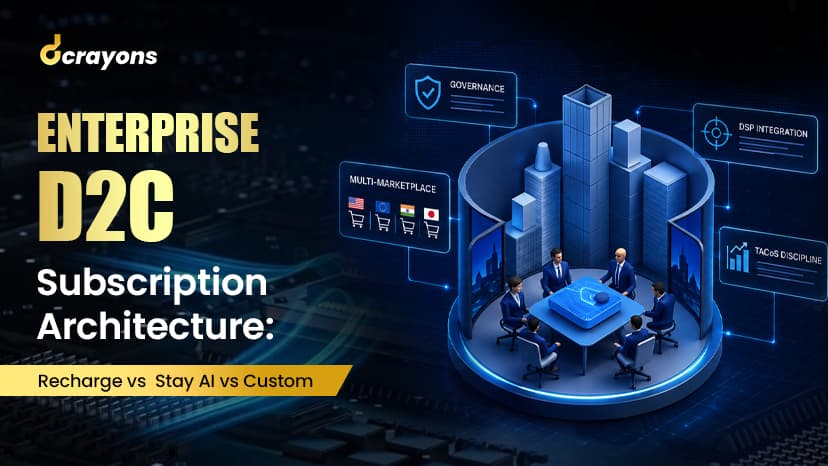
Enterprise Amazon presence is structurally different. The enterprise operator runs across 3-7 marketplaces simultaneously (Amazon.in + Amazon.ae + Amazon.sa + Amazon.co.uk + Amazon.com being the typical India-house international expansion shape), maintains Brand Registry + A+ Content + Brand Storefronts across every marketplace, holds Vendor Central + Seller Central accounts in parallel for the same brand-line, navigates marketplace-specific account-health thresholds (Order Defect Rate, Late Shipment Rate, Cancellation Rate, Inventory Performance Index) with different thresholds + different appeals processes per marketplace, runs daily inventory + ad-spend + listing-quality monitoring with automated guards, and treats each marketplace as a distinct P&L with its own contribution margin economics.
This piece is the reference architecture and governance discipline Dcrayons applies on enterprise Amazon engagements in 2026. It covers four areas the public Amazon SPN documentation under-foregrounds: the multi-marketplace operations topology, the Account Health + Inventory Performance Index governance discipline, the catalog + Brand Registry pattern that survives multi-locale + counterfeit pressure, and the operational pattern past Rs 100 crore Amazon ARR.
Multi-marketplace operations topology
The enterprise multi-marketplace footprint requires deliberate organisational + system architecture. Single-account thinking fails at this scale.
Per-marketplace account topology. Each marketplace requires its own Seller Central and/or Vendor Central account, tied to a regional entity (Indian Pvt Ltd for Amazon.in, GCC entity for Amazon.ae + Amazon.sa, UK entity for Amazon.co.uk, US entity or IOR + tax-rep arrangement for Amazon.com). Tax registration, customs broker, regional bank account, and IOR (Importer of Record) all parallel-track per marketplace. A common failure mode is using a single Indian entity for all marketplaces; the tax + import + currency-repatriation complications compound over years.
Per-marketplace team structure. Each marketplace has a dedicated account-management owner; cross-marketplace coordination happens at the portfolio-management level + at the catalog-master level. The wrong pattern: one person manages "Amazon" across 5 marketplaces; the same person cannot hold the case-by-case account-health rules, regional shopper context, regional ad nuances, and regional partner relationships for all five.
Operational system stack. Beyond Seller Central / Vendor Central, the operational stack includes: a SP-API integration platform (Sellerginni, Helium 10, Jungle Scout, Sellics, or custom. for ad management + competitor tracking + listing-quality monitoring), a PIM (Akeneo, Salsify, custom) for catalog-master + per-marketplace overrides, an OMS (Shipworks, Linnworks, ShipStation, or custom) for order-of-record + multi-marketplace order reconciliation, a 3PL integration layer per marketplace (FBA + FBM), an ERP (NetSuite, SAP, Oracle, Tally, Zoho) for financial consolidation across all marketplaces.
Vendor vs Seller architecture decision. For each brand-line, the decision: Vendor (Amazon buys your products at agreed cost; Amazon owns retail + pricing + customer service) or Seller (you sell direct to Amazon shoppers; you own pricing + fulfillment via FBA or FBM; Amazon collects + remits). Vendor offers scale + Amazon-driven marketing + better-than-Seller advertising surfaces (Sponsored Brands stronger placement); Seller offers control + better margin + direct customer relationship. Enterprise brands often run both: top SKUs as Vendor (for the scale + control of Amazon retail), tail SKUs as Seller (for the margin + control). The "1P + 3P hybrid" architecture is the enterprise default.
Account Health + Inventory Performance Index governance
The fastest path to enterprise Amazon-revenue disaster is account suspension. Account suspension hits when account-health metrics breach thresholds; restoration takes 2-12 weeks (sometimes never); the revenue loss compounds with no recovery path. Enterprise governance prioritises account-health monitoring + early-warning intervention + appeal-readiness above all other tactical optimisation.
The Dcrayons Account Health governance pattern:
Daily account-health dashboard per marketplace. Order Defect Rate (target less than 1 percent), Cancellation Rate (target less than 2.5 percent), Late Shipment Rate (target less than 4 percent), Valid Tracking Rate (target above 95 percent), Pre-Fulfillment Cancel Rate, Return Dissatisfaction Rate, Customer Service Dissatisfaction Rate, Policy Violations + Suspected Intellectual Property Violations + Product Authenticity Customer Complaints. Each metric per marketplace, trended daily.
Inventory Performance Index (IPI) discipline. IPI is FBA-specific; below the marketplace threshold (440 for most marketplaces, varies) triggers storage limits + storage fees. IPI drivers: stranded inventory + excess inventory + in-stock rate + sell-through. Weekly IPI review + inventory-action playbook (remove excess, restock low, fix stranded listings) is the cadence.
Early-warning intervention. Each metric has a yellow-line + red-line threshold below the official marketplace threshold. Yellow-line breach triggers ops review within 48 hours; red-line breach triggers immediate escalation + incident response. Operating in the yellow zone for 3+ weeks triggers process review (not just metric chasing).
Suspension playbook. Documented step-by-step incident response for account suspension scenarios: which person investigates within 1 hour, which person drafts the Plan of Action within 24 hours, which person escalates to Amazon Account Management contact (the SPN partner channel) within 48 hours, what evidence + commitments + corrective-actions are documented. Practiced annually via tabletop exercise; the playbook is not a slide deck the team reads when the suspension happens.
Appeals + reinstatement specialists on retainer. For brands with revenue exposure greater than Rs 50 lakh per day on a marketplace, the cost of a 2-week suspension exceeds Rs 7 crore. Retaining a specialist appeals firm at Rs 50K-2 lakh per year for priority response is the insurance posture. The Dcrayons SPN-track partnership + the specialist appeals firm provide redundant paths.
SP-API monitoring + automation. Account health + listing health + ad health are monitored via SP-API + AmzCraft-style automation. Alerts for: listings going inactive, listings losing buy box, listings stranded in inbound shipment, ASINs going out-of-stock, IPI dropping toward threshold, repeated A-to-Z claim patterns. Automated alerting + automated initial response (e.g., auto-restock-suggestion, auto-bid-down on out-of-stock) shrink the operational team's monitoring load.
Catalog + Brand Registry pattern
Listing quality + Brand Registry status + A+ Content + Brand Storefront freshness are the discoverability + conversion-rate fundamentals. They are also the IP-protection + counterfeit-defence fundamentals. The Dcrayons catalog + Brand Registry pattern:
PIM-driven catalog master. Akeneo, Salsify, or a custom PIM holds the product master: title-template per marketplace, bullet-point variants per locale, A+ Content modules per region, brand-storefront content per marketplace, image library with image-naming convention, video library, parent-child-variation logic. Editing happens once in the PIM; per-marketplace publish via SP-API.
Listing-quality monitoring. Daily SP-API queries + Helium 10 / AmzCraft-style monitoring for: listings with low listing-quality-score, listings missing A+ Content, listings missing key bullet points, listings with image-quality issues, listings with backend-keyword issues. Daily report + weekly remediation queue.
Brand Registry maintenance. Active Brand Registry status per marketplace (different registration per marketplace), trademark renewals tracked + at least 9 months before expiry, brand-registry brand-page maintained, IP-violation reporting workflow active. The brand-registry admin role is held by the IP-specialist function, not by the marketplace-ops team.
A+ Content + Brand Storefront freshness. A+ Content coverage at 90+ percent of active ASINs; Brand Storefront refreshed at least quarterly (more often around major events: Diwali, Prime Day, BFCM, Republic Day, GITEX, Eid, Boxing Day); Posts published weekly across the marketplaces that support Posts.
Vine + Customer Engagement programmes. Vine enrollment for new-launch ASINs (gets 30 trusted-reviewer reviews quickly for legitimate launches); Customer Engagement email programme for repeat-purchase nudges + cross-sell within the brand's catalog. Both via Brand Registry.
Counterfeit + brand-protection workflow. Documented intake + response for: counterfeit listings (Test Buy + Brand Registry takedown), hijacker sellers on legitimate ASINs (Brand Registry transparency programme + serialised codes), price-floor violations (MAP policy + monitoring), counterfeit complaint from a customer (Customer Service template + Amazon investigation). Weekly counterfeit-takedown queue + monthly brand-protection report.
Pricing + buy-box governance
Buy-box ownership is the conversion-rate fundamental on Amazon. Losing the buy-box to a competitor seller (legitimate or hijacker) drops the brand's conversion + ad-attributed revenue from that ASIN to near zero. The Dcrayons pricing + buy-box pattern:
MAP (Minimum Advertised Price) policy + enforcement. Documented MAP policy per marketplace, communicated to authorized resellers, enforced via Brand Registry transparency + monitoring + cease-and-desist for violators. Without MAP enforcement, distribution partners undercut the brand's own listings and the brand loses buy-box.
Buy-box-share monitoring. Daily SP-API queries for buy-box-share per ASIN per marketplace. Less than 90 percent buy-box-share on a high-revenue ASIN triggers investigation: third-party seller on the listing? competitive pricing pressure? FBA-vs-FBM seller advantage? Out-of-stock? Each cause has a documented response.
Repricing strategy. Algorithmic repricer (Feedvisor, Bqool, RepricerExpress, or custom) repriced to the MAP floor + competitive-but-defensible margin; never below MAP. Repricer logic + caps reviewed monthly.
FBA preference. FBA listings hold buy-box more reliably than FBM listings at the same price. Top-tier ASINs run FBA; tail-tier ASINs can run FBM with adjusted pricing. The FBA-vs-FBM decision per ASIN is a quarterly review.
Operational pattern past Rs 100 crore Amazon ARR
Enterprises past Rs 100 crore Amazon ARR across marketplaces apply these disciplines:
Marketplace P&L per marketplace. Each marketplace is a P&L with: revenue, FBA / FBM cost, ad spend, return rate, contribution margin per SKU, marketplace fees, currency-exchange impact, tax. The CFO reviews per-marketplace P&L monthly; capital allocation decisions per marketplace are made on contribution-margin economics, not revenue alone.
Catalog-mastery upstream of listing. Every new SKU goes through the PIM with: titles per locale, bullet points per locale, A+ Content modules, image library, parent-child variation logic, MAP price per marketplace, FBA preparation requirements. Listings created without this PIM-mastery are the source of long-tail catalog-debt.
Quarterly cross-marketplace strategy review. Capital allocation across marketplaces, brand-storefront strategy, launch calendar per marketplace, ad-budget allocation per marketplace, inventory-planning per marketplace, MMM-driven channel mix (Amazon vs DTC vs offline) per region.
Inventory planning + S&OP integration. Amazon-marketplace demand-forecast feeds the brand's S&OP process. Inventory planning treats FBA inventory + DTC inventory + offline-channel inventory + 3PL inventory + manufacturer inventory as a unified plan. FBA Restock Limit per region + IPI + storage-fee economics are constraints in the planning model.
Event-readiness playbook per marketplace. Prime Day (annual), Diwali (Amazon.in), BFCM (Amazon.com + Amazon.co.uk), Boxing Day (Amazon.co.uk), Republic Day (Amazon.in), GITEX (Amazon.ae), White Friday (Amazon.ae + Amazon.sa), Eid (Amazon.ae + Amazon.sa), Single's Day (where Amazon participates). Each event has documented prep, inventory plan, ad plan, creative plan, monitoring plan.
Production checklist: the rollout sequence
For an enterprise Amazon presence at Rs 100+ crore Amazon ARR across 3+ marketplaces:
- Regional entity + tax registration + IOR per marketplace established
- Seller Central + Vendor Central accounts per marketplace, Vendor-vs-Seller architecture decided per brand-line
- Brand Registry active + maintained per marketplace, trademark renewal calendar
- PIM-driven catalog master, per-marketplace localised feeds, SP-API publish pipeline
- A+ Content + Brand Storefront live + refreshed quarterly per marketplace
- Account Health daily dashboard per marketplace, yellow + red thresholds + intervention playbook
- Inventory Performance Index weekly review + inventory-action playbook
- Suspension playbook + appeals firm on retainer + annual tabletop exercise
- SP-API monitoring + automation for listing health + buy-box-share + IPI early-warning
- MAP policy enforced + repricer running + buy-box-share daily monitoring
- Counterfeit + brand-protection workflow active, weekly takedown queue
- Vine + Customer Engagement programmes for launches + retention
- Per-marketplace P&L + S&OP integration with Amazon demand forecast
- Event-readiness playbooks per marketplace per major event
- Reporting cadence: daily / weekly / monthly / quarterly with named owners
References + linked context
- Amazon documentation: Brand Registry, Account Health, Inventory Performance Index, SP-API, A+ Content, Brand Storefronts
- Dcrayons glossary: brand-registry, account-health, ipi, vendor-central, buy-box, map-policy
- Dcrayons Amazon Ads reference architecture: see /learn?tag=amazon-ads for the multi-marketplace ad-portfolio + AMC + TACoS discipline Amazon presence pairs with
- AmzCraft platform: Dcrayons-built SP-API + automation platform for account health + listing health + bid + inventory guard
If your enterprise Amazon presence has hit a multi-marketplace coordination wall, an account-health crisis, or a catalog-quality + brand-registry decay problem, this is the architecture we deploy. Reach out via the contact form for a 30-minute review against your current setup.