Context: where the enterprise D2C on Shopify question gets harder
Most Indian D2C brands start on Shopify, hit Rs 5-10 crore ARR, and then face the question: do we stay on Shopify, upgrade to Shopify Plus, or rebuild headless on Hydrogen + Vercel? The wrong answer wastes 6-12 months of velocity. The right answer depends on specific architectural constraints the customer is hitting, not on hitting an abstract revenue threshold.
The Plus marketing pitch suggests every brand at Rs 8-15 crore ARR should upgrade. The headless content suggests every brand should go headless once they have Plus. Both narratives over-simplify. The honest decision framework looks at the specific constraints the customer is actually facing: checkout customisation that standard Shopify cannot do, multi-store operational complexity, API rate limits, B2B + retail unification, multi-region deployment, or front-end performance on the median Indian 4G device.
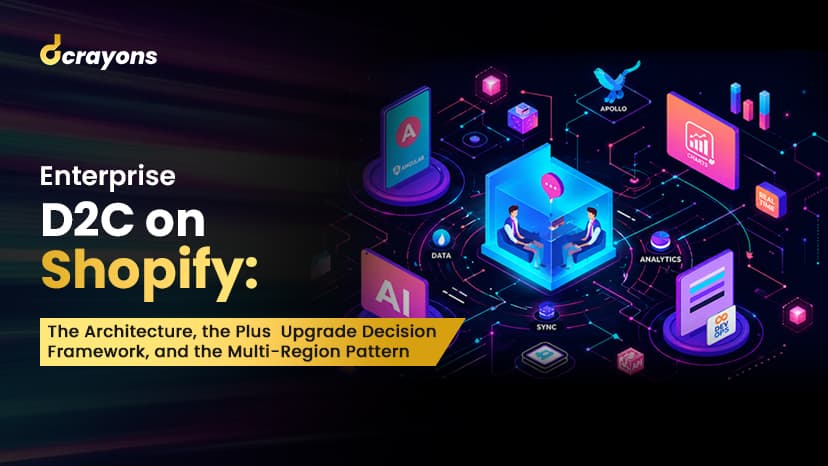
This piece is the reference architecture and decision framework Dcrayons applies on enterprise Shopify engagements in 2026. It covers four areas the public documentation does not assemble in one place: the stay-vs-Plus vs headless decision framework, the multi-region commerce-stack pattern for India + GCC + UK, the integration spine that connects Shopify to the rest of the enterprise stack, and the operational discipline that scales past Rs 25 crore ARR.
The decision framework: Shopify Standard vs Plus vs Headless
The right Shopify deployment shape is dictated by the customer's specific constraints, not by abstract revenue thresholds. The Dcrayons decision matrix:
Stay on Shopify Standard when: - Revenue under Rs 8-10 crore ARR with no specific Plus-only feature constraint - Single brand, single region (or single primary region with light international) - Standard discount engine + standard payment + standard shipping rules cover the actual commerce logic - No multi-store operational complexity (one storefront is enough) - API rate limits not biting (standard tier supports most brands at this scale)
Upgrade to Shopify Plus when: - A specific feature constrains the business: Functions needed for cart logic the standard engine cannot express, Checkout Extensibility needed for B2B unified flow, Launchpad needed for sale-event automation, Plus Organisation needed for multi-store consolidation - Multi-store operations across brands or regions (3+ storefronts argues for Plus regardless of per-store revenue) - B2B + retail unified architecture required (the native Plus B2B model is materially cleaner than any Plus-Standard hybrid) - Hitting Shopify Standard API rate limits during sale events or background sync operations - Revenue typically Rs 15-25 crore ARR or above
Rebuild headless on Hydrogen / Next.js + Vercel when: - Front-end performance constraints that Plus checkout speed cannot solve (typically these are theme-bloat issues solved by rebuild, not Plus issues) - Design + interaction complexity that breaks the Liquid template model - Integration with non-commerce content (large editorial sections, complex search, AI-driven personalisation) that wants a unified front-end - Multi-region edge delivery where Plus's hosted theme delivery is too slow for the customer's distant audiences - Engineering team (yours or your agency's) capable of maintaining a Next.js + Storefront API app indefinitely
The wrong shape is choosing Plus before there is a specific Plus-only feature constraint, or rebuilding headless before there is a specific front-end constraint. We have rolled brands BACK from Plus to Standard when the upgrade did not solve a real problem; we have rolled brands BACK from headless to Standard theme when the engineering cost did not justify itself. Honest framework over default upgrades.
Multi-region commerce-stack pattern
For Indian D2C brands operating across India + GCC + UK (the most common enterprise expansion shape), the multi-region Shopify pattern:
One Shopify Plus organisation, multiple stores per region. Each region gets its own store with region-specific currency, payment rails (Razorpay for India, Telr or Stripe for GCC, Stripe for UK), shipping rates, tax rules, and locale-specific content. The Plus organisation provides centralised user management + consolidated analytics across all regional stores.
Customer Data Platform layered above. Segment, RudderStack, or a custom CDP unifies customer records across the regional stores. A customer who bought from the India store and the UAE store appears as one identity in the CDP even if they appear as separate customer records in each Shopify store. Marketing automation, lifecycle email, and loyalty programmes reference the CDP-unified identity.
Catalog source of truth. For brands selling the same SKUs across regions, the catalog source of truth typically lives in a PIM (Akeneo, Salsify, or the customer's homegrown system). The PIM pushes product data to each regional Shopify store with region-specific overrides (price, availability, currency, tax category). Editing happens once in the PIM; regional stores update via API.
Inventory management. Shopify Plus stores can share inventory pools where regional fulfilment justifies it; otherwise each store carries its own inventory. The 3PL integration (Shiprocket / Delhivery for India, Aramex for GCC, DPD for UK) is per-region.
Order data warehoused centrally. Order data from all regional stores flows to the customer's data warehouse (Snowflake / BigQuery) via Shopify webhooks + Operations Hub or a custom ETL. The warehouse is the single source of truth for cross-region revenue + customer analytics.
The integration spine: Shopify connected to the rest of the enterprise stack
Enterprise Shopify rarely runs alone. The Dcrayons integration spine pattern:
Accounting + invoicing. Shopify orders push to the customer's accounting system (Tally, Zoho Books, NetSuite). For Indian B2B customers, GST invoicing automation generates the GST-compliant invoice with the buyer's GST number captured at checkout via Checkout Extensibility.
Logistics. Shiprocket, Delhivery, or the customer's 3PL integrates via Shopify Apps or custom webhook handlers. Order created -> shipping label generated -> tracking URL pushed back to the order -> customer notified.
Marketing + lifecycle. Klaviyo (or HubSpot for B2B-skewed customers) integrates for email + SMS + WhatsApp lifecycle. Customer events (purchase, abandoned cart, subscription change, refund) push to Klaviyo; Klaviyo flows fire based on event triggers.
Analytics + attribution. Google Analytics 4, Meta Conversions API (CAPI), Google Ads conversion tracking integrate at the checkout level. CAPI is server-side via Shopify's native integration; GA4 is client-side via the gtag.js bundle.
Returns + reverse logistics. ReturnGo, Loop Returns, or a custom RMA system integrates for the post-purchase flow. Return-rate metrics flow back to the analytics warehouse.
Subscriptions. Recharge, Stay AI, Skio (or a custom subscription system) integrate for recurring orders. Each handles dunning, swap-the-product, skip-this-month workflows; Shopify stays the order-of-record.
The Dcrayons integration discipline: every integration has a documented owner, a signature-validated webhook path, structured logs, and a quarterly health-check review. Integrations that drift unobserved are the silent killer for enterprise commerce ops.
Operational discipline past Rs 25 crore ARR
The brands that scale past Rs 25 crore ARR on Shopify (Plus or otherwise) and do not collapse operationally apply these disciplines:
Theme deployment via CI. Theme code lives in a private GitHub repo. Every theme change goes through a pull request with mandatory review + automated lint + automated Lighthouse regression check. Direct push to the live theme is disabled. The Plus organisation enforces this.
App stack governance. Apps require justification before installation. An "App Audit" is run quarterly: which apps are installed, which are actually used, which can be removed. App-stack bloat is the slow-killer for Shopify performance at scale.
Sale event readiness. BFCM, Diwali, Republic Day, brand-specific drops follow a documented prep playbook (T-60 inventory plan, T-30 catalog overrides, T-14 ad creative, T-7 Launchpad rehearsal, T-0 live monitoring). Sale event ops is a quarterly discipline, not an ad-hoc scramble.
Customer service routing. Service tickets route per region + per product line. Indian customers get Indian-time-zone agents; UK customers get UK-time-zone agents. Routing is at the help-desk tool level (Zendesk, Gorgias, Intercom), not in the customer's head.
Reporting cadence. Daily revenue + AOV + conversion rate by region. Weekly cohort + retention + LTV. Monthly product margin + return-rate. Quarterly cross-channel attribution + customer-acquisition-cost trend. The reporting is automated; humans review on cadence.
Production checklist: the rollout sequence
For an enterprise D2C on Shopify (Standard or Plus) at the Rs 25 crore+ ARR scale:
- Decision framework applied: Standard vs Plus vs headless confirmed against actual constraints
- Plus organisation provisioned (if Plus), multi-store topology mapped (if multi-region)
- Theme repository in customer's GitHub, CI deploy pipeline, branch protection on production
- App stack governance: approved-app list, install controls, quarterly audit
- Customer Data Platform layered above (Segment / RudderStack / custom) if multi-region
- PIM integration (if applicable): catalog single-source-of-truth, regional override flow
- Integration spine: accounting + logistics + marketing + analytics + subscriptions each owned + monitored
- Checkout Extensibility (Plus): shared component library, per-store overrides explicit
- Functions (Plus): shared library, deployment via CI, audit log for compliance changes
- Sale event playbook: 60-day prep cycle documented, Launchpad rehearsal cadence
- Reporting + observability: daily / weekly / monthly / quarterly cadence + dashboards
- Compliance: GST invoicing, DPDP / GDPR consent capture, customer-data export workflow
References + linked context
- Shopify Plus documentation: Organisation Admin, B2B, Functions, Checkout Extensibility
- Dcrayons glossary: shopify-plus, hydrogen, storefront-api, conversion-rate, aov
- Dcrayons Plus reference architecture: see /learn?tag=shopify-plus for the multi-store + Functions + B2B governance pattern
If your D2C brand is at the Shopify stay-vs-Plus decision point, or you are scaling a multi-region Shopify operation past Rs 25 crore ARR, this is the framework and architecture we deploy. Reach out via the contact form for a 30-minute review against your current setup.