Context: why subscription architecture decides the unit economics
For Indian D2C brands past Rs 10 crore ARR, the choice of subscription architecture is no longer a "which app on Shopify" question. It is a unit-economics question that defines: gross margin per active subscriber, customer LTV, churn elasticity to interventions, fraud rate, dunning recovery rate, and the ability to run multi-product / bundled / variable subscriptions without taking the storefront offline.
The wrong subscription architecture can quietly cost a brand 15-30 percent of subscription revenue through preventable churn + failed payments + over-reliance on first-month-free promotions to mask the underlying retention problem. The right architecture turns subscriptions into the highest-margin + most-predictable line of the P&L.
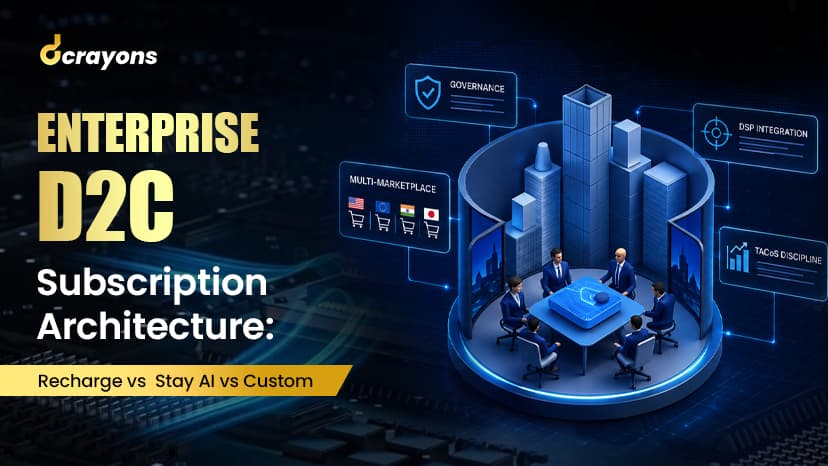
This piece is the reference architecture Dcrayons applies on enterprise D2C subscription engagements in 2026. It covers four areas: the platform decision (Recharge vs Stay AI vs Skio vs custom), the integration spine, the churn + dunning discipline, and the operational pattern past Rs 25 crore ARR.
The platform decision: Recharge vs Stay AI vs Skio vs custom
The 2026 D2C subscription platform landscape:
Recharge. The veteran. Largest ecosystem, deepest integrations (Shopify + Klaviyo + Postscript + every major 3PL), broadest feature surface (subscriptions + memberships + bundles + payment methods + dunning + portals). Right when: scale is high (over Rs 30 crore subscription ARR), integration breadth matters, the team wants the safest + most-supported option.
Stay AI. The 2023-2024 challenger that gained material share among DTC-first brands. Strengths: native AI-driven retention features (intelligent dunning, churn prediction, upsell automation), modern admin UX, faster product velocity. Right when: team values product velocity + AI-driven retention, customer base is digitally native.
Skio. The newer entrant focused on flexibility + customer-portal UX. Strengths: cleaner customer-portal experience (swap, skip, gift), competitive pricing, growing ecosystem. Right when: customer-portal UX matters strategically, the brand is willing to bet on a newer platform.
Smartrr / Bold / Loop / Recurpay. Other meaningful options in 2026, each with niche strengths (Smartrr loyalty + memberships, Bold for established Shopify shops, Loop for returns + subscriptions, Recurpay India-focused billing).
Custom on Shopify Plus + Stripe / Razorpay. The right architecture for enterprises where the subscription product is too unique for off-the-shelf (multi-month variable shipping, B2B subscription with quote-on-renew, hybrid usage-based + recurring). Trade-off: 3-6 month build + ongoing engineering ownership vs the off-the-shelf 2-week setup.
The Dcrayons rule: default to Recharge for established Shopify brands above Rs 30 crore ARR. Default to Stay AI for mid-market DTC-first brands that value modern UX + AI features. Reach for custom only when the subscription product genuinely doesn't fit off-the-shelf models.
The integration spine: where subscriptions plug into the rest of the stack
Subscriptions are not isolated. The integration spine determines whether the subscription system supports the rest of the operating motion.
Order-of-record + reconciliation. Shopify holds the order-of-record; the subscription platform creates Orders in Shopify on each renewal. The accounting system (Tally, Zoho Books, NetSuite) pulls Orders from Shopify for GST invoicing + revenue recognition. Reconciliation between subscription platform billing + Shopify orders is a daily job.
Payment retry + dunning. Failed payments retry on a defined schedule (typically day 1, day 3, day 5, day 7) with progressive payment-update prompts to the customer. The platform's native dunning + Klaviyo email + Postscript SMS form a coordinated dunning campaign. Recovery rate from 30-50 percent of failed payments is normal with a good dunning system.
Customer portal. Customers swap products, skip a shipment, gift, pause, or cancel via the portal. The portal UX is a material driver of self-service + churn reduction. Native portal vs custom-built: native is faster, custom gives total UX control.
Marketing automation. Klaviyo / HubSpot / MoEngage receives subscription lifecycle events: subscription started, charge succeeded, charge failed, swap, skip, cancellation. Lifecycle flows fire based on these events: pre-renewal nudge, post-charge thank-you, cancellation save-flow, win-back after cancellation.
Inventory + fulfilment. The subscription platform generates the upcoming-shipment schedule per active subscriber. The 3PL (Shiprocket, Delhivery, ShipBob) consumes the schedule to plan capacity. Forecast accuracy matters: a subscription book of 50,000 active subscribers shipping monthly means roughly 1,700 shipments per day. the 3PL needs early signal.
Analytics + retention modeling. Subscription cohort retention curves, churn driver analysis, LTV modeling all live in the warehouse (Snowflake / BigQuery), fed by the subscription platform's event stream.
Churn + dunning discipline: where the margin comes from
Two operational levers drive subscription unit economics: voluntary churn (customers actively cancel) and involuntary churn (payments fail).
Voluntary churn intervention. The customer initiates cancellation; the portal shows a save-flow (skip this month, pause for 30 days, swap product, downgrade tier, offer a one-time discount). Save-flow design matters: too aggressive and customers feel trapped (negative reviews + brand damage); too passive and you lose churners who would have stayed at a small concession.
The Dcrayons save-flow rule: offer the lightest intervention first (skip / pause), escalate only if the customer continues toward cancellation, never block the cancel button. Save rates of 15-25 percent on the cancellation flow are good; over 30 percent usually means the flow is too coercive.
Involuntary churn intervention. Failed payments retry per schedule. Each retry is paired with a customer message (email + SMS) showing "Your payment failed, update card here" with a one-click portal link. Card-update friction is the silent killer: a 3-step flow vs a 1-step deep link makes a 10-15 percent recovery rate difference.
Pre-renewal customer comms. 3-5 days before each charge, the customer gets a renewal-preview email + the option to swap products + delivery preview. This drops involuntary churn at the source: customers who don't want this month's shipment skip it BEFORE the charge fails.
Churn driver tagging. Cancellation reasons captured in a structured taxonomy (price, frequency, product, life event, switched-to-competitor). Weekly review of the top cancellation drivers + assign owners to attack them. Without this discipline, you optimise the save-flow without fixing the underlying causes.
Operational pattern past Rs 25 crore subscription ARR
Brands that scale past Rs 25 crore subscription ARR apply these disciplines:
Daily reconciliation. Subscription platform billing vs Shopify orders vs payment gateway settlements. reconciled daily. Discrepancies above a threshold trigger investigation within 24 hours. Quiet drift between systems is how brands lose 2-5 percent of subscription revenue to silent breakage.
Multi-tier customer support. Subscription support is its own queue, separate from new-acquisition support. Trained agents who know swap / pause / skip / downgrade workflows. SLA on subscription queue tighter than general queue: 4 business hours for first response.
Quarterly retention deep-dive. Cohort curves by acquisition channel, by product, by tier, by month-of-acquisition. Identify which cohorts retain better; double down on the acquisition channels + product configurations that produce them.
A/B testing discipline. Save-flow variations, dunning-message copy, pre-renewal email send-time, portal-UX variations. all A/B tested with proper statistical rigor. Win-rate of A/B tests in subscription ops is typically 30-40 percent (many ideas don't ship), but the cumulative impact is large.
Annual platform review. Is the current subscription platform still the right one? Are we hitting feature ceilings? Are there new entrants worth evaluating? Migrating subscriptions is painful but possible; the platform decision is not forever.
Production checklist: the rollout sequence
For an enterprise D2C subscription programme at Rs 25 crore+ subscription ARR:
- Platform decision locked: Recharge / Stay AI / Skio / custom (against the criteria above)
- Order-of-record + reconciliation: Shopify primary, daily reconciliation against subscription platform + payment gateway
- Dunning + retry schedule + customer comms documented
- Customer portal live with swap / skip / pause / gift / cancel + tested mobile
- Klaviyo / Postscript lifecycle flows wired to subscription events
- Inventory + fulfilment forecast pipeline; 3PL gets daily shipment-schedule feed
- Cohort retention dashboard in the warehouse + quarterly deep-dive cadence
- Save-flow design + A/B tested + cancellation-reason taxonomy captured
- Subscription support queue with dedicated SLAs + trained agents
- Compliance: GST invoicing automation per renewal, DPDP-consent capture on subscription opt-in
- Annual platform review documented + decision-record
References + linked context
- Dcrayons glossary: oms, tacos, buy-box
- Dcrayons Shopify Plus reference architecture: see /learn?tag=ecommerce for the multi-store + Functions + B2B governance pattern subscription architecture pairs with
If your enterprise D2C subscription programme is fighting churn, payment failures, or a platform-fit question, this is the architecture we deploy. Reach out via the contact form for a 30-minute review against your current setup.