Context: lifecycle marketing as a revenue line
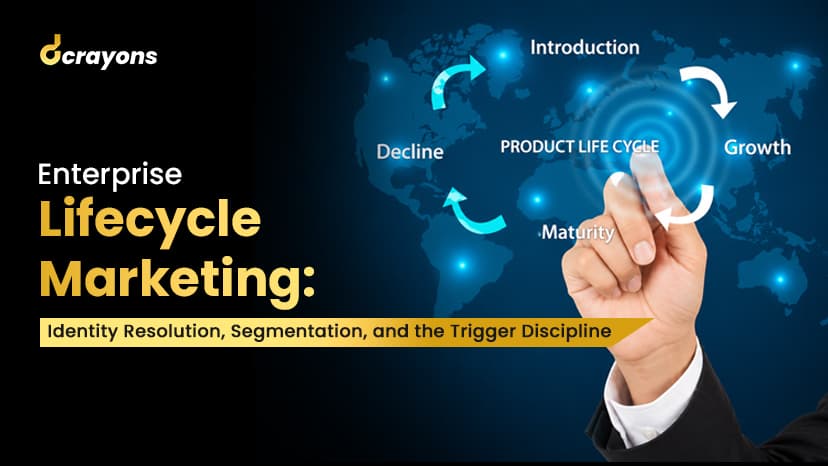
For mature enterprise D2C brands, lifecycle marketing (email + SMS + WhatsApp + push + in-app + direct mail) drives 20-40 percent of total revenue. For SaaS + B2B services brands, it drives 30-50 percent of pipeline. Done well, lifecycle is the highest-margin marketing channel because acquisition cost is essentially zero per send. the customer is already in the database.
Done poorly, lifecycle is the brand's biggest source of recipient fatigue, reputational damage, and gradual deliverability erosion. The line between the two is operational discipline: identity resolution, segmentation, and trigger architecture.
This piece is the reference architecture Dcrayons applies on enterprise lifecycle engagements in 2026. It covers four areas: identity resolution across channels, segmentation discipline that survives multi-brand + multi-region scale, the trigger architecture pattern, and the operational cadence that drives sustainable revenue contribution.
Identity resolution: making one customer one record
The fundamental shape of lifecycle marketing is "the right message to the right person at the right time on the right channel". Every word in that sentence requires identity resolution. the same customer must be recognisable across web sign-up + mobile-app login + WhatsApp opt-in + email subscribe + offline purchase + in-store visit.
The Dcrayons identity resolution pattern:
Master identity in the CDP. Segment, RudderStack, or a custom CDP holds the canonical customer record. Every channel reports events to the CDP; the CDP applies merge rules to identify which events belong to which person.
Merge rules. Email (hashed) is the primary key. Phone (hashed, E.164 normalized) is the secondary. Device ID + cookie / advertising ID are tertiary, used for pre-login attribution. Loyalty program ID or customer-ID from the commerce platform is the strongest deterministic link.
Conflict resolution. When two records merge (one customer logs in on a new device), the merge rule defines which fields win: most-recent timestamp, most-trusted source, or explicit user input. Documented per field.
Cross-region identity. A customer who bought from the India store + the UAE store appears as ONE identity in the CDP (linked by hashed email). Marketing automation references the unified identity; regional commerce platforms see two separate customer records (which is correct. different shipping addresses, different payment methods, different tax). The CDP bridges.
Anonymous-to-known transition. Pre-login web traffic is identified by anonymous_id (cookie / device). On sign-up or login, the anonymous_id stitches into the known identity. All prior anonymous behaviour now joins the known customer record. The stitch happens server-side via the CDP, not client-side.
Segmentation discipline: from "all customers" to actionable cohorts
A common failure mode is the "send-to-all" pattern: every promotional email goes to the full list. Open rates decay, unsubscribes climb, deliverability erodes. The solution is segmentation discipline.
The Dcrayons segmentation framework:
RFM segments (Recency / Frequency / Monetary). Every customer scored on three axes: how recently did they purchase, how often, how much. RFM segments (Champions, Loyal Customers, At Risk, About to Sleep, Hibernating, Lost) drive different lifecycle treatments.
Behavioural segments. Engaged-Email (opened past 30 days), Engaged-Site (visited past 14 days), Cart-Abandoner (added to cart, didn't buy in 7 days), Browse-Abandoner (viewed product 3+ times, didn't buy). These drive trigger flows.
Lifecycle stage segments. Subscriber (opted in, never purchased), First Purchase (bought once), Repeat (bought 2-5 times), Loyalist (bought 6+ times), Loyalist-At-Risk (was loyalist, hasn't bought in 90 days). These drive content + tone + offer depth.
Product-affinity segments. Customer's purchase history clusters them into product categories: skincare-buyer, supplements-buyer, fashion-buyer. Cross-sell triggers reference these.
Consent-tier segments. Email-opted-in, SMS-opted-in, WhatsApp-opted-in. DPDP + GDPR + sectoral regulation requires consent to be channel-specific. Every send checks consent BEFORE the trigger fires.
Geographic + locale segments. Region + city + locale. Multi-region brands send region-specific promotions; multi-locale brands send locale-specific content.
Segments compose. A real-world trigger: "Send the BFCM-skincare-upsell SMS to (RFM=Loyal) AND (product-affinity=skincare) AND (consent-tier=SMS-opted-in) AND (region=India) AND (last-SMS-sent over 7 days ago)".
Trigger architecture: events, flows, exits
A trigger is a marketing automation flow that fires when a customer-event matches a condition. The trigger architecture defines: which events feed the system, which flows listen to which events, how flows handle conflicts, and when they exit.
Event sourcing. Every customer action gets logged as a typed event with a timestamp: signed_up, viewed_product, added_to_cart, removed_from_cart, checkout_started, checkout_completed, purchase_completed, refunded, subscription_started, subscription_paused, subscription_cancelled, support_ticket_opened, email_opened, email_clicked, sms_clicked, app_opened.
Flow design. Each flow has: entry trigger (the event + condition), sequence of steps (send email, wait 1 day, check condition, branch, send SMS, exit), exit conditions (customer converted, customer unsubscribed, customer entered a conflicting flow). 15-25 flows is typical for a mature D2C lifecycle programme.
Suppression + send-rate caps. No customer receives more than N messages per day across all flows. Each flow declares its priority; high-priority sends (cart abandonment, payment failure) take precedence over low-priority (broadcast newsletter). Without this discipline, customers get spammed when multiple flows fire concurrently.
A/B testing per flow. Subject line variants, send-time variants, content variants, send-channel variants (email vs SMS vs WhatsApp). Statistical significance enforced; winning variants ship.
Send-time optimisation. Klaviyo + Iterable + Braze offer send-time-optimisation algorithms that pick the best hour per recipient. The improvement vs a fixed send time is typically 10-20 percent in open rate. Use it.
Eventual consistency awareness. An event takes seconds-to-minutes to propagate through the CDP + ESP + lifecycle platform. Flows that fire on event X must tolerate that X arrives a few minutes late. Designing flows assuming instant event delivery breaks at scale.
Operational cadence: the weekly rhythm
Lifecycle programmes need an operational cadence to produce sustained revenue contribution. The Dcrayons cadence:
Daily. Send-volume monitoring per flow, deliverability dashboards (open rate, click rate, unsubscribe rate, complaint rate, bounce rate), suppression-list health, send-cap breach alerts. Anomalies (open rate dropped by 50 percent vs baseline) get same-day investigation.
Weekly. Top 5 flows by revenue, top 5 by engagement, A/B test results, new-flow proposals reviewed. Send-time + subject-line winners shipped. Cancellation-reason taxonomy review (for subscription brands).
Monthly. Cohort revenue contribution by flow, cross-channel flow attribution (which flows drive revenue across email + SMS + WhatsApp + push together), retention curves, segmentation health (are segments still meaningful or have they drifted).
Quarterly. Programme strategy review: what's working, what's been tried-and-failed, what new flows or channels to add, deliverability + reputation review with the ESP, consent + compliance audit.
Production checklist: the rollout sequence
For an enterprise lifecycle marketing programme at Rs 50+ crore ARR:
- CDP master identity (Segment / RudderStack / custom) with documented merge rules
- Event schema governance: typed events, versioned schemas, documentation per event
- RFM + behavioural + lifecycle stage + product-affinity + consent-tier segmentation
- 15-25 lifecycle flows designed + documented (welcome, post-purchase, replenishment, cross-sell, win-back, cart-abandonment, browse-abandonment, etc.)
- Send-rate caps + priority hierarchy + suppression rules
- Channel mix per customer: email + SMS + WhatsApp + push, consent-tracked per channel
- A/B testing infrastructure + statistical-significance gating
- Send-time + subject-line + content optimisation per flow
- Deliverability monitoring: open / click / unsubscribe / complaint / bounce per ESP
- Daily / weekly / monthly / quarterly cadence with named owners
- Compliance: DPDP / GDPR consent capture, double opt-in, unsubscribe-honoured-immediately, regulator-friendly audit log
- Quarterly programme review with CMO + Head of CRM + Dcrayons
References + linked context
- Dcrayons glossary: cdp, marketing-automation, lifecycle-stage, customer-360
- Dcrayons HubSpot reference architecture: see /learn?tag=martech-crm for the multi-hub + integration-spine pattern lifecycle marketing pairs with
If your enterprise lifecycle programme is hitting an identity-resolution wall, segmentation drift, or trigger-architecture chaos, this is the pattern we deploy. Reach out via the contact form for a 30-minute review against your current setup.