Context: the multi-region enterprise problem Vercel solves
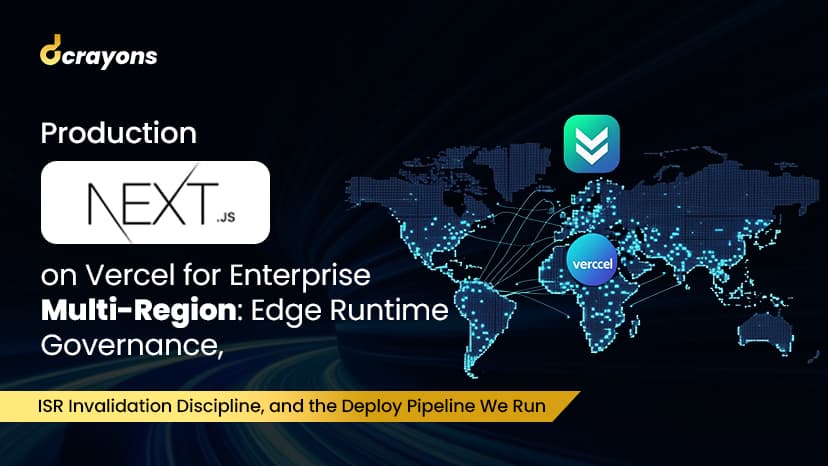
Indian and GCC enterprise teams shipping on Next.js have a specific operational problem that the documentation does not always foreground. The user base spans Mumbai, Bangalore, Dubai, London, and Toronto. The content origin is one. The marketing site, the customer portal, the documentation, and the search experience all need to feel native-fast across every geography. A single-origin deployment in Mumbai serves Mumbai well and London badly; a single-origin deployment in Frankfurt serves London well and Mumbai badly. The classic CDN-in-front-of-origin pattern with WordPress used to be the answer; for modern apps with server-rendered routes and personalisation it is not.
Vercel solves this with a runtime model that places per-request server logic at edge points-of-presence (POPs) close to the user, with cached static and ISR-rendered routes served from the closest POP, and a deploy pipeline that ships every git push as an isolated preview environment before merge. This piece is the reference architecture Dcrayons deploys for enterprise customers running Next.js at scale across multiple geographies. It covers four things: the runtime placement decision (edge vs Node serverless vs static vs ISR per route), the ISR invalidation discipline (the bug that takes down enterprise marketing teams), preview-deploy security (the gap that surprises CISOs), and the observability baseline we ship from day one.
Architecture: the runtime placement decision
A production Next.js app on Vercel is not one runtime. It is four, applied per route based on the route's actual workload:
Edge Runtime is the Web-standards subset that runs at edge POPs in milliseconds. No Node-specific APIs (fs, raw process.binding, etc.). The right fit is auth checks, geolocation-driven personalisation, A/B test variant assignment, header rewriting, and tenant + locale resolution. The deploy unit is the middleware or route file with export const runtime = 'edge' declared. Cold-start is sub-50ms. For an Indian customer hitting the site from Bangalore, the edge function executes in Vercel's Bangalore POP rather than a US data centre.
Node Serverless Runtime runs the full Node.js standard library at Vercel's regional functions. Used when a route needs npm packages that require Node primitives (pg, mysql2, native modules, child_process). Slower cold-start than Edge (200ms-1.5s depending on bundle size), but no API restrictions. Most database-touching routes live here.
Static (SSG) is the build-time rendered HTML, served from the CDN with no runtime invocation. Right for content that does not change per user and rarely changes per request (marketing pages, About, legal pages, brochure documentation). Cost is near-zero at serve time; the trade-off is build-time + content staleness.
Incremental Static Regeneration (ISR) is the middle ground: pre-rendered at build, served like static, but invalidated and regenerated on a configurable revalidation window or on-demand via tag-based invalidation. Right for catalog-style routes (products, blog posts, location pages, glossary terms) where the page is mostly static but content changes occasionally. The first visitor after invalidation triggers regeneration in the background; subsequent visitors get the fresh version from the CDN.
The Dcrayons rule for runtime placement on enterprise builds: default to ISR for catalog routes (revalidate window 60-300 seconds based on edit cadence), Edge Runtime for middleware and personalisation-decided routes, Node Serverless for routes that touch the database or filesystem, Static for routes that have no dynamic data at all. The choice gets logged in a runtime-strategy doc per project; deviations require sign-off because runtime placement directly maps to cost and performance.
ISR invalidation: the discipline that prevents the "stale content" page-1 incident
The ISR invalidation question is where most enterprise Next.js teams have a quiet bug. The default ISR pattern is time-based: a route revalidates after N seconds. This works until an editor publishes a content change, sees it on the preview deploy, expects to see it in production within seconds, and finds that the page is still showing yesterday's content because the revalidation window has not elapsed.
The fix is on-demand revalidation via tag-based invalidation. In the Next.js App Router, each ISR route can declare cache tags (fetch(url, { next: { tags: ['blog-post',post-${id}] } })). When the CMS publishes a change, a webhook calls revalidateTag('post-<id>'), which invalidates exactly the affected routes at the edge. The next visitor sees the new content immediately; unaffected routes are not invalidated unnecessarily.
The discipline we apply at Dcrayons enterprise engagements:
- Every ISR route declares cache tags for the entities it depends on (blog post, category, site settings, navigation)
- The CMS (Sitecore, Contentful, or our own .NET CMS) publishes a webhook to a revalidation endpoint on every content save
- The revalidation endpoint validates the webhook signature (typically HMAC-SHA256 with a per-tenant secret), maps the changed entity to its cache tags, and calls
revalidateTagper tag - A weekly cost-and-coverage report shows which routes invalidated how often, which surfaces over-invalidation (wasted regeneration) and under-invalidation (stale content) early
This is the layer that consistently breaks for enterprise teams that adopted ISR without the invalidation infrastructure. The bug is invisible until a content team escalates "why is the page wrong"; the fix is structural, not a config switch.
Preview-deploy security: the gap that surprises CISOs
Every git push triggers a Vercel preview deployment with a unique URL. This is a productivity feature. It is also a security surface that enterprise teams routinely under-govern. Default preview URLs are accessible to anyone with the link. For marketing-content review this is fine. For dashboards, internal admin pages, or any deployment containing real customer data, default-open is the wrong posture.
The pattern we deploy for enterprise customers:
Vercel Authentication on preview environments. Vercel's Pro and Enterprise plans support SSO-gated preview deployments. Every preview URL requires the visitor to authenticate against the customer's identity provider (Okta, Azure AD, Google Workspace). Anonymous link sharing stops working; preview URLs become a real product-team review tool rather than an accidental exposure surface.
Per-branch environment variable isolation. Preview deployments should not have access to production secrets. The right pattern is: production environment variables scoped to the main branch deployment only, preview environments get a separate set of staging-credentials with limited blast radius (read-only DB access, sandboxed payment provider, no production email sender keys).
Branch protection on production. Direct push to main is disabled. All production deployments go through a pull request with mandatory review, mandatory CI status checks, and a clean preview deployment evaluated by a human reviewer. The Vercel + GitHub integration enforces this when configured correctly.
This is the layer that turns Vercel from "fast preview workflow" into "fast preview workflow that survives the customer's annual penetration test."
Observability baseline: what we wire on day one
Production Next.js without observability is a black box that occasionally serves errors. The Dcrayons enterprise baseline includes:
Vercel Analytics + Speed Insights for the application-level performance data (Largest Contentful Paint, Cumulative Layout Shift, First Input Delay, per-route and per-region). Vercel surfaces these natively without additional integration.
Sentry (or the customer's APM of choice) for runtime errors with full stack traces, user context attached, and release tagging for regression tracking. We instrument every Server Action and edge function with explicit error capture; the default uncaught-exception behaviour is too coarse for production diagnosis.
Structured server-side logging to a customer-controlled log store (typically AWS CloudWatch or an enterprise log aggregator like Datadog / Splunk if the customer mandates one). Every server request logs: route, method, status, latency, runtime placement (edge / serverless / static), region, tenant ID, and any business-critical context (order ID, user ID for non-anonymous routes).
Cost monitoring at the Vercel team level with alerts on +20 percent week-over-week deviation. Vercel Pro and Enterprise have function-execution and bandwidth meters that we surface on a customer-shared dashboard. Cost surprises in month 2 are a sign of either a regression (an Edge Runtime route accidentally promoted to Node serverless) or unexpected traffic, and either warrants investigation.
Cost discipline: the levers we use on enterprise Next.js
A production enterprise Vercel deployment can hit five-figure monthly bills if architecture is naive. Three levers we apply:
Right runtime per route, religiously. Every route promoted from Edge Runtime to Node serverless multiplies execution cost by 5-much higher. Catching incorrect runtime placement during code review (not in production) is the cheap path.
Image optimisation tuned to traffic mix. Vercel's image optimiser is excellent but priced per transformation. For high-traffic D2C catalog sites we configure image sizes to match the actual viewport breakpoints in use (no rebuilding an image to 2400px when no breakpoint uses it), and we offload commonly-cached images to a customer-owned CDN where the transformation savings justify the integration cost.
ISR cache tuning. Over-eager revalidation invalidates routes that have not actually changed, triggering regeneration cost. Under-eager revalidation shows stale content. The right setting is per-route, informed by editor cadence + traffic shape, reviewed quarterly.
Production checklist: the rollout sequence we run
For an enterprise Next.js + Vercel programme:
- Procurement: Vercel Pro or Enterprise plan signed, with SSO provider details for preview-deploy authentication
- Repository: monorepo or single-repo decided, branch protection on
main, code-owner files for content + infrastructure paths - Environment variables: production secrets locked to
main-deployment scope, preview environment using staging credentials, no secret in.env.example - Runtime strategy: per-route placement documented (Edge / Serverless / Static / ISR), runtime declared in code, deviations flagged in PR review
- ISR invalidation infrastructure: cache tags declared per route, CMS webhook signature validation, revalidation endpoint deployed, weekly invalidation report wired
- Preview-deploy security: SSO-gated previews, per-branch env-var scoping, branch protection enforced
- Observability: Analytics + Speed Insights enabled, Sentry instrumented, structured server-side logging to customer log store, alert rules on error-rate + cost deviation
- Performance budget: per-route Lighthouse + Web Vitals targets agreed with the customer, blocked PRs that regress targets
- Cost monitoring: function-execution + bandwidth dashboards shared with customer, weekly cost review, alert on +20 percent week-over-week
- Deploy pipeline: GitHub Actions CI status checks blocking production merges, runbook for rollback to previous deployment in under 60 seconds
- Handover: customer team trained on preview-deploy workflow, branch model, ISR revalidation, cost dashboards
References + linked context
- Vercel documentation: Edge Runtime, ISR, on-demand revalidation, Vercel Authentication, environment variables
- Next.js App Router: cache tags, server actions, runtime exports
- Dcrayons production reference:
new.dcrayons.appruns on Lightsail with the Next.js standalone build pattern; we use the Vercel-equivalent shape with self-hosted infrastructure for customers requiring it - Dcrayons glossary: edge-runtime, isr, vercel-ai-gateway, preview-deployment
If your enterprise Next.js programme has hit a multi-region performance wall, an ISR invalidation incident, or a preview-deploy security gap, this is the architecture we deploy. Reach out via the contact form for a 30-minute review against your current setup.