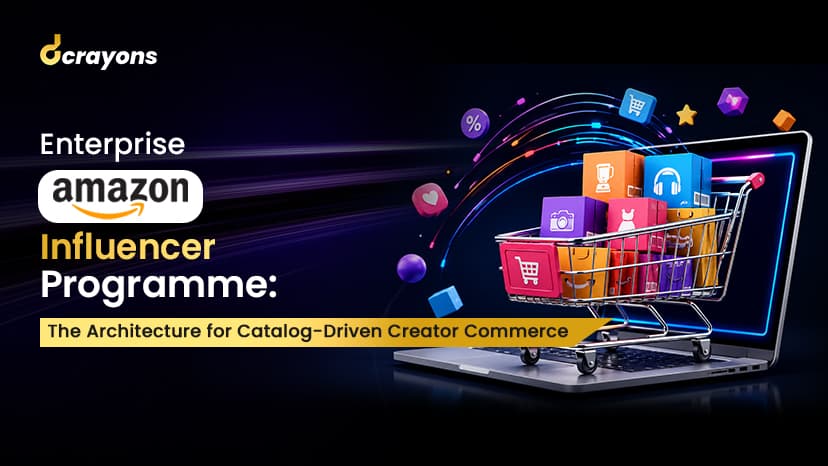
Amazon's Influencer Programme was a curiosity in 2020. By 2026 it's a meaningful channel for D2C brands operating at scale on Amazon.in, Amazon.ae, and Amazon.com. Brands at Rs 30 crore+ Amazon ARR running an organised influencer programme attribute 6-15 percent of their Amazon revenue to creator-driven traffic.
This is the reference architecture we apply on enterprise Amazon Influencer engagements. It covers creator onboarding, content workflow, attribution, payouts, and the brand-protection discipline that prevents the programme from quietly becoming a counterfeit-distribution channel.
What the Amazon Influencer Programme actually is
Two distinct things share the name. They get conflated; they shouldn't.
| Programme | Who's enrolled | How they monetise |
|---|---|---|
| Amazon Influencer Programme | Approved creators (TikTok, Instagram, YouTube minimums) | Get a personalised storefront + commissions on referred sales |
| Amazon Live | Creators streaming live shopping | Same enrollment basis; live video is the medium |
The Influencer Programme is the creator-driven content channel. Amazon Live is the live commerce variant of it. Most brand engagement is via the Influencer Programme storefronts + their product carousels.
The mechanics
A creator gets an Amazon Influencer Storefront URL (amazon.in/shop/creator-handle). They curate product collections, share that URL on their social channels, and earn commissions on referred sales. The standard commission ranges 1-10 percent depending on category.
For brands, the channel works two ways:
- Passive: creators include your products organically in their storefronts because the products fit their audience. You don't manage the relationship.
- Active: you cultivate specific creators, brief them, agree on additional brand payments beyond Amazon's standard commission, and treat them like influencer partners on a normal marketing engagement.
Most brands at scale run both. The passive layer drives baseline volume; the active layer drives strategic moments (launches, sale events, category pushes).
Why this channel matters more in 2026 than it did in 2023
Three shifts in the last 24 months:
- TikTok Shop integration with Amazon. Indian creators with TikTok presence can now route TikTok audiences directly to Amazon storefronts; the friction of platform switching dropped.
- Amazon's algorithmic preference for creator-driven traffic. Internal Amazon search now subtly favours products with active creator promotion, especially in fashion + beauty + home.
- The shopper trust gap. Generic Amazon listings face declining trust; creator-vetted listings carry more credibility, especially with female + Gen-Z audiences.
Brands that ignored creator partnerships through 2023 are now allocating 5-12 percent of their Amazon-budget to creator programmes.
Creator onboarding: who actually moves the needle
Most brands waste budget on creators who don't drive Amazon sales. The pattern is consistent: high-follower creators on Instagram with low Amazon conversion because their audience doesn't shop on Amazon.
The four creator tiers
| Tier | Profile | Right use case |
|---|---|---|
| Tier 1 (mega, 1M+ followers) | TV / film celebrities, top influencers | Brand-awareness moments, launch hype |
| Tier 2 (macro, 100K-1M) | Established category creators | Sustained product education, key moments |
| Tier 3 (mid-tier, 10K-100K) | Niche category specialists, often Amazon-Live regulars | Highest ROI for most D2C brands; specific category authority |
| Tier 4 (nano, under 10K) | Amazon Influencer Programme members with active storefronts | Highest aggregate volume; passive + low-touch active partnerships |
For most Indian D2C brands at Rs 30 crore Amazon ARR, the volume comes from Tier 3 + Tier 4. Tier 1 + Tier 2 deliver brand-awareness but rarely the highest ROI on the actual Amazon channel.
How to identify the right creators
Three signals matter more than follower count:
- Amazon Storefront activity: do they actually curate + update their storefront? A creator with 50K followers + an active Amazon storefront beats a creator with 500K followers + no storefront.
- Category fit: are they actually in your category? A beauty creator pushing skincare products outperforms a generic lifestyle creator pushing the same products.
- Past brand work quality: have they worked with other brands? Was the content thoughtful or transactional? The pattern persists.
Tools for vetting: Amazon's Influencer Discovery (limited but growing), Modash, GRIN, CreatorIQ, and increasingly Amazon's own internal Brand Tailored Promotions data.
Content workflow: from brief to live
The four-stage workflow
Stage 1: brief. Brand provides:
- Products to feature (ASINs + key talking points)
- Brand voice + claims-substantiation guardrails
- Sale event windows if applicable
- Required deliverables (storefront update + a specific number of social posts + optional video)
- Timeline + payment terms
Stage 2: creator concepting. Creator proposes:
- How the product fits their content
- Specific posts + storefront positioning
- Estimated audience reach + relevant
- Pricing for the brand-payment portion (Amazon commission is separate)
Stage 3: approval + production. Brand reviews + signs off on the content concept BEFORE production. Once approved, creator produces + ships within agreed timeline.
Stage 4: distribution + measurement. Content goes live on creator channels + storefront. Brand monitors attribution via Amazon Attribution + creator-specific UTM tags. Performance reviewed at 7 + 30 days.
The seven things to lock in writing
The contract / partnership agreement covers:
- Exclusive windows (if any). period during which the creator does NOT promote competitor products
- Content rights. who owns the content after the campaign; can the brand reuse it
- Disclosure requirements. ASCI / FTC compliance on sponsored content
- Performance milestones. payment tied to delivery, not promised results (legally safer)
- Brand-safety triggers. if the creator's broader content turns problematic, contract exit options
- Exclusivity vs non-exclusivity. can the creator work with your competitors
- Payment terms. net-30 from delivery is standard; net-7 for high-trust ongoing partners
Without these in writing, the relationship works fine 80 percent of the time and produces expensive disputes the other 20 percent.
Attribution + Amazon Attribution programme
Measuring creator impact on Amazon requires Amazon's own tooling.
Amazon Attribution (free for Brand Registry holders)
Amazon Attribution lets brands generate trackable URLs that report click-through, detail-page views, and purchases per source. The free version (available to Brand Registry holders) works for most enterprise needs.
The workflow:
- Create a measurement tag in Amazon Attribution for each major creator campaign
- Give the creator the trackable URL to use in their posts + storefront
- After the campaign, see actual purchases attributed to that creator + that campaign
This is the only way to measure individual creator ROI accurately. Without it, you're estimating + arguing.
Creator-specific UTM tags
Beyond Amazon Attribution, layer UTM-style tracking via Amazon's URL parameters. Each creator gets a unique tag visible in your Amazon Brand Analytics + (if you have it) your Amazon Marketing Cloud (AMC) queries.
The honest attribution conversation
Amazon Attribution + AMC give you a strong attribution view. The remaining attribution gap: dark traffic from creator influence that doesn't click the trackable URL (a follower hears about the product, later searches Amazon directly + buys).
For enterprise programmes, run periodic incrementality tests: hold out one region or one creator tier for 4-6 weeks, measure baseline shift. Annual incrementality + monthly attribution + quarterly portfolio review is the discipline.
Brand protection: the failure mode that ends programmes
The biggest risk in any Amazon Influencer Programme: unauthorised resellers + counterfeit products entering the channel via creator endorsement.
Three failure modes:
| Failure | Mechanism | Defence |
|---|---|---|
| Creator promotes a counterfeit version | Knockoffs of your product exist on Amazon; creator unknowingly picks one | Brand Registry transparency + creator pre-approval workflow |
| Creator endorses an unauthorised reseller | Reseller has stock; creator's commission is higher | Authorised-seller list provided to creators upfront |
| Creator content is hijacked by a competing brand | Competitor product is recommended in the comments or in the creator's other content | Creator agreement clauses + regular content audit |
The Dcrayons brand-protection discipline
- Brand Registry + Transparency programme active. Without these, you have no enforcement mechanism. With them, counterfeit listings can be reported + removed.
- Authorised-seller list shared with creators upfront. Creators only point at listings from authorised sellers (your own brand storefront + approved distributors).
- Pre-approval on the specific Amazon URL the creator uses. Brand approves the EXACT listing URL before content production.
- Monthly content audit for active creators. Are they still using the approved listings? Have third-party listings crept in?
- Cease-and-desist workflow for unauthorised use. When competitors use your brand name in creator content without authorisation, documented escalation: creator outreach → Amazon IP complaint → legal action.
Payouts + commercial mechanics
Amazon-side commissions
Amazon pays creators directly on Amazon Influencer Programme sales. Brand has no role in this payment. Commission rates per category:
- Beauty + personal care: 4-10 percent
- Fashion: 4-8 percent
- Home + kitchen: 3-5 percent
- Electronics: 1-3 percent
- Books: 4-5 percent
These rates change annually; check current Amazon Associates rate card.
Brand-side payments
Active partnerships layer brand payments on top:
| Engagement type | Typical Indian brand payment range |
|---|---|
| One-off Instagram post with Amazon link | Rs 25,000 - 5 lakh per post (creator-tier dependent) |
| Multi-post campaign (3-5 posts over 2 weeks) | Rs 1-15 lakh |
| Storefront permanent feature (3-6 months) | Rs 50,000 - 8 lakh |
| Live commerce session on Amazon Live | Rs 30,000 - 3 lakh per session |
| Exclusive launch partner (3-6 month exclusivity) | Rs 5-50 lakh |
Add product seeding cost (Rs 5,000 - 2 lakh per creator depending on category) + occasional flagship gifting.
Performance milestones
The standard milestone structure for a partnership:
- 30 percent on contract signing + product delivered
- 30 percent on content shipped + approved
- 40 percent at 30 days (some agreements tie this to performance metrics; others to mere completion)
GST + invoicing
Indian creators above the GST threshold (Rs 20 lakh annual revenue, or Rs 10 lakh for services) must issue GST invoices. Below threshold, they may not. Brand-side accounts: every payment is recorded as a marketing expense; large payments may attract TDS (10 percent under Section 194J for professional services; consult your CA).
What does an enterprise programme look like in practice?
A real-world snapshot of an Indian D2C beauty brand at Rs 60 crore Amazon ARR:
- Active creator partnerships: 40-60 creators across Tiers 2-4
- Storefront passive footprint: 200-400 creators feature the brand organically
- Annual creator-programme spend: Rs 1.5-3 crore (brand payments + production support; Amazon commissions are separate)
- Attribution: ~10 percent of Amazon revenue attributable to creator-channel traffic (post-incrementality adjustment)
- Team: 1 partnerships lead + 1 specialist + Dcrayons as agency-of-record
- Cadence: weekly partnership pipeline, monthly performance review, quarterly tier rebalance
Programme ROI consistently 2.5-4x net of all costs at this scale.
Production checklist
For an enterprise Amazon Influencer Programme at Rs 25 crore+ Amazon ARR:
- Brand Registry + Transparency active per marketplace
- Creator-tier strategy documented (which tiers, what % of budget per tier)
- Creator vetting framework (Amazon storefront activity + category fit + past work quality)
- Standard contract template covering the 7 items above
- Amazon Attribution tags configured per creator campaign
- Authorised-seller list shared with creators upfront
- Monthly content audit for active creators
- Brand-payment structure agreed + GST + TDS workflow documented
- Performance milestone-based payments (not promised-results)
- Annual incrementality test on creator-channel impact
- Quarterly portfolio review: which creators to renew, which to retire, which tier to grow
- Compliance: ASCI / FTC disclosure adherence, regional sensitivity review
References + linked context
- Dcrayons glossary: tacos, brand-registry, buy-box
- Dcrayons Amazon reference architectures: Enterprise Amazon Ads Portfolio Strategy, Enterprise Amazon Presence
- Related: Enterprise D2C on Shopify
If your Amazon programme has hit a creator-channel question, an attribution gap, or a brand-protection concern in the influencer programme, reach out via the contact form for a 30-minute review.