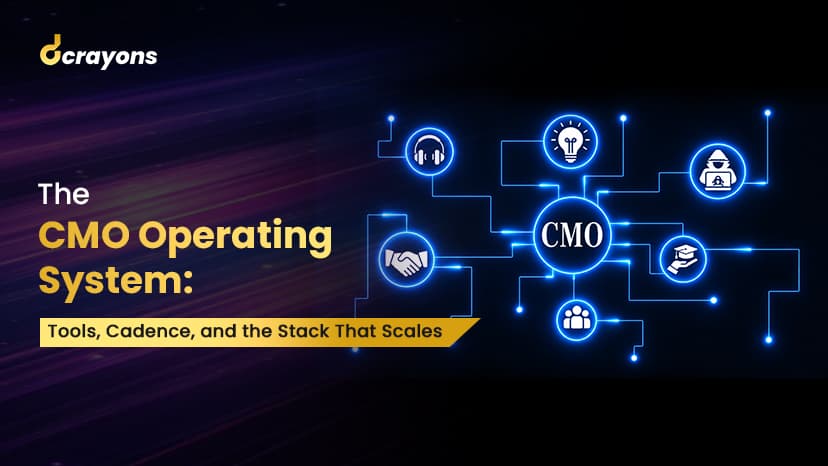
The CMO role evolved more between 2020 and 2026 than in the previous twenty years. In 2020 CMOs ran creative + brand. In 2026 they run revenue, technology, customer experience, data, content, and brand together. The job description didn't keep up; the CMOs who succeed did, by building a personal operating system that handles the expanded surface area.
This is the operating system pattern we see consistently behind effective CMOs at Rs 50 crore - 500 crore ARR. It covers the tooling stack, the decision cadence, the governance posture, and the personal discipline that separates productive marketing leaders from busy ones.
What "operating system" means for a CMO
Not the OS on the laptop. The personal + organisational system the CMO runs:
| Component | What it answers |
|---|---|
| Information layer | What data hits my desk, when, in what form |
| Decision layer | What decisions I make personally vs delegate |
| Cadence layer | What meetings happen + how often + with whom |
| Team layer | Who reports to me + how I support them |
| Self layer | How I protect attention + energy across a 5-day-a-week role |
A CMO without an operating system runs on heroic effort + good luck. A CMO with one runs on discipline + system + sustainable energy.
The information layer: what data actually reaches you
Most CMOs drown in reports + still don't have the data they need. The fix isn't more dashboards; it's curating the input stream.
Tier 1: hits the CMO inbox daily
| Metric | Source | Format |
|---|---|---|
| Revenue + bookings yesterday | Warehouse or CRM-side report | 1-line summary email or Slack message at 9 AM |
| Spend yesterday vs plan | Marketing platforms aggregator | 1-line summary |
| Anomaly alerts | Custom monitoring | Only when anomaly detected |
3 data points. That's it. Daily inbox should not have 17 marketing reports.
Tier 2: weekly review
| Metric | Source | When |
|---|---|---|
| Last week's blended ROAS, CPA, CAC | Warehouse | Monday morning report |
| Last week's cohort-day-7 metrics | Analytics platform | Monday morning |
| Pipeline health (B2B) | CRM | Monday morning |
| Brand health (sentiment, share of voice) | Listening platform | Monday morning |
Reviewed Monday in 30-45 minutes; informs the week's focus.
Tier 3: monthly + quarterly deep-dive
| Metric | Source | When |
|---|---|---|
| Cohort retention by acquisition channel | Warehouse | Month-end |
| LTV by cohort + segment | Warehouse + CRM | Month-end |
| Channel-marginal-ROAS (MMM output) | MMM platform | Quarterly |
| Brand-attribute tracking (survey-based) | Brand research | Quarterly |
| Competitor positioning + share of voice | Strategic intel | Quarterly |
These don't hit the inbox daily. They sit in scheduled reviews; the CMO blocks calendar time to read them.
The discipline
If a report doesn't drive a decision, kill it. If a metric isn't reviewed at one of the cadences above, why is it being computed? Most marketing teams over-instrument + under-decide.
The decision layer: what the CMO decides vs delegates
A common failure mode: the CMO becomes the approver-of-everything. Calendar fills with approval meetings. Strategic work doesn't happen. The team waits on decisions instead of executing.
Decisions the CMO personally makes
| Decision | Frequency |
|---|---|
| Quarterly budget allocation across channels | Quarterly |
| Major creative direction shifts | As needed (typically 2-3 per year) |
| Senior hires (head of growth, head of brand, channel managers) | As needed |
| Vendor selection above Rs 25 lakh annual contract | As needed |
| Crisis response on P1 issues | Same-day |
| Brand voice + positioning changes | Annual + as needed |
| Marketing P&L management | Monthly |
Decisions the CMO delegates (with framework)
| Decision | Delegated to | Framework |
|---|---|---|
| Channel-specific tactics within budget | Channel manager | Budget envelope + ROAS target |
| Day-to-day creative decisions | Brand lead + channel leads | Brand voice guide + claims register |
| Campaign launches within approved themes | Channel managers | Calendar-approved themes + budget |
| Vendor selection under Rs 25 lakh | Function leads | Documented procurement framework |
| Tactical hiring (associates, specialists) | Function leads | Headcount plan + role profile |
| Content calendar within editorial guide | Content lead | Editorial guide + brand voice rules |
The delegation pattern: define the frame; trust the people in the frame. If you can't trust them, you have a hiring problem, not a control problem.
The escalation protocol
Decisions that don't fit cleanly into "I decide" or "you decide" need a documented escalation:
- Function lead attempts to decide using the framework
- If stuck or above their authority, brings to CMO with: the situation, the options, their recommendation, the reasoning
- CMO decides (or escalates to CEO if above CMO authority)
- Decision documented for the next similar situation
Documented decisions become the framework's evolution.
The cadence layer: meetings that earn their place
A meeting that doesn't result in a decision or a clear plan is theatre. The CMO operating cadence keeps meetings useful.
Daily
9 AM scan (15 minutes, solo). Read the daily 3-data-point inbox. Note anything anomalous. Decide if the day needs a re-prioritisation.
Weekly
Monday: Marketing leadership team (60 minutes). Highlights from last week. Decisions needed this week. Risks emerging. Each function lead reports for 5 minutes; CMO directs.
Wednesday: 1:1 with each function lead (30 min each). Their priorities, their blockers, their growth. CMO coaching, not status reporting.
Friday: CMO solo block (90 minutes). Strategic thinking time. No meetings. Used for: reading deep reports, preparing for the next week, working on strategic projects.
Monthly
1st Monday: Founder / CEO update (30 min written + 30 min live). Numbers, narrative, asks, decisions needed.
Last Friday: Cross-channel review (90 min). What's working across channels, what isn't, attribution conversation, budget signals.
Mid-month: Marketing ops + tooling review (45 min). Tool health, data quality, integration uptime.
Quarterly
OKR planning (1-2 days). Last quarter's results, next quarter's OKRs.
Brand + creative review (half-day). Brand consistency, drift, refresh needs.
Cross-functional partnership review (2 hours). Marketing x product, marketing x sales, marketing x finance. Half the work is alignment outside marketing.
Annual
3-5 day strategic offsite. Where marketing needs to be in 12 months. Budget, hiring, tooling, capability gaps.
Tooling stack annual review. What works, what to consolidate, what to add.
Operating model review. Does the current team + decision rights + cadence still fit?
The tooling stack: 2026 reality
The 2026 enterprise marketing stack is a federation of best-of-breed tools. The CMO's job is choosing them + governing how they fit together.
The core stack
| Layer | Common choices | Annual cost (Rs) |
|---|---|---|
| CRM | HubSpot Enterprise, Salesforce, custom | 15-100 lakh |
| Marketing automation | Klaviyo, Marketo, MoEngage, Iterable | 10-60 lakh |
| CDP | Segment, RudderStack, mParticle, custom | 15-80 lakh |
| Warehouse | Snowflake, BigQuery, Redshift, ClickHouse | 8-40 lakh |
| BI / dashboards | Looker, Tableau, Mode, Metabase, Hex | 6-50 lakh |
| MMM | Meta Robyn, Google Meridian, vendor | 5-50 lakh |
| Brand listening | Brand24, Mention, Talkwalker, Sprinklr | 8-50 lakh |
| Content / DAM | Cloudinary, Bynder, Sirv | 4-25 lakh |
| ABM (B2B) | 6sense, Demandbase, RollWorks | 15-100 lakh |
| Project management | Asana, Linear, Notion, Monday | 3-15 lakh |
| Ad platforms (operational tools) | Sprout, Hootsuite, Sprinklr, native | 5-50 lakh |
Total: Rs 95-620 lakh per year for the full stack. Most teams under-spend by trying to do everything in HubSpot or over-spend by buying tools they don't operate.
Tooling discipline
- Documented owner per tool. Every tool has one person responsible. No ownerless tools.
- Quarterly utilisation review. Are we using what we're paying for?
- Consolidation bias. Two adjacent tools doing similar things should consolidate; one tool serving multiple functions wins until it can't.
- Vendor renewal calendar. Know the renewal date 90 days out. Negotiate before the auto-renewal trap.
The team layer: hiring + retention
The CMO's job is not to do the work. It's to build the team that does the work. Two patterns dominate.
Hire for the next stage, not the current one
If you're at Rs 30 crore ARR + planning to be at Rs 100 crore, hire the head of growth who has run Rs 100 crore programmes. They'll be over-qualified for now + right-sized in 12-18 months. Hiring someone who fits today means re-hiring in 12 months.
Retention beats hiring
Replacing a senior marketing hire costs 12-24 months of productivity (3-6 months to ramp, 6-12 months to perform, lost institutional knowledge). Retaining them costs less. Retention levers in 2026:
- Career growth path documented. they should see the next 18-month progression
- Compensation reviewed annually + actually adjusted. not just performance-management theatre
- Autonomy + decision authority. micromanagement is the leading cause of senior-marketing departures
- Brand pride. they should be proud to tell people where they work
- Real coaching from the CMO. 1:1s that grow them, not just sync status
The self layer: how the CMO stays sustainable
The CMO role in 2026 spans 50-60 hours per week if you let it. The CMOs who last build personal sustainability.
Calendar discipline
- Solo blocks every day. 2-4 hour stretches with no meetings, used for thinking + strategic work
- No back-to-back meetings beyond 3 hours. 15-minute buffers between meetings + a 60-minute block at lunch
- Friday afternoon protected. reserve for the week's strategic synthesis + setting the next week's focus
Information diet
- Limit the daily inbox to high-signal sources. kill the 12 marketing newsletters that don't actually change your thinking
- Read deeply once a quarter. a long book, an industry report, a competitor deep-dive. Not skim-reading 15 blog posts.
Energy management
- Sleep ahead of time-zone shifts. multi-region CMOs deal with calls across IST + GST + UK + US. Plan the sleep schedule.
- Travel discipline. every trip has clear purpose; refuse the ones that don't.
- Quarterly disconnect. 5-7 days fully offline. The team should be able to operate without you for a week.
Production checklist
For a CMO operating system at Rs 50 - 500 crore ARR:
- Daily inbox limited to 3 data points + anomaly alerts
- Weekly + monthly + quarterly + annual cadence documented
- Decision-rights matrix for the 12-15 most common decision types
- Escalation protocol documented
- Tooling stack reviewed annually with documented owners + utilisation
- Vendor renewal calendar tracked
- OKR framework adopted (3 objectives per quarter)
- Hiring plan + retention strategy for the marketing team
- Personal calendar discipline: solo blocks + meeting buffers + Friday strategic block
- Quarterly disconnect (5-7 days offline per quarter)
- Cross-functional governance (marketing x product x sales x finance)
- Annual operating-model review + adjustment
References + linked context
- Dcrayons reference architectures: The Operating Model Behind High-Performing D2C Teams, Enterprise Lifecycle Marketing, Enterprise HubSpot
- Dcrayons glossary: okr, marketing-automation, cdp, customer-360
The CMO role expanded faster than the playbook for it. If you're a CMO trying to build the operating system that keeps you effective + sustainable, reach out via the contact form for a 30-minute conversation.