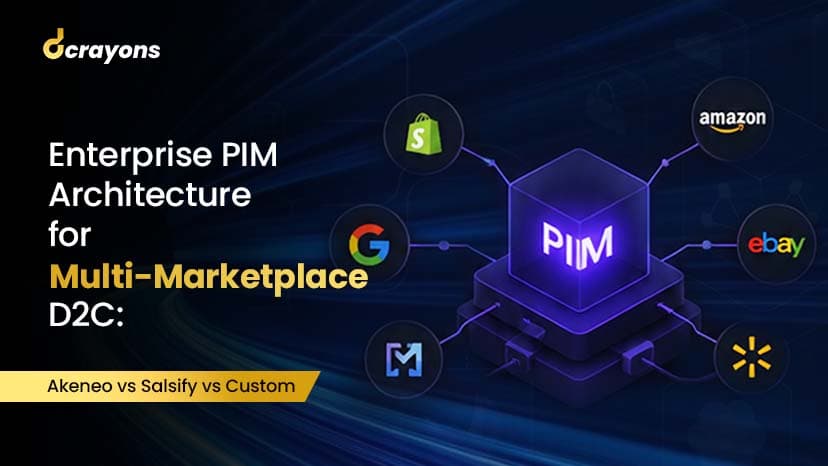
A D2C brand selling on Shopify alone has one product catalog. The same brand selling on Shopify + Amazon.in + Amazon.ae + Flipkart + Myntra + Nykaa has six product catalogs, each in a slightly different shape, each needing slightly different titles + descriptions + images + attributes, each with its own update cycle. Without architecture, the team manually edits six places every time a SKU changes. With architecture, they edit once and the change propagates.
This piece is the PIM (Product Information Management) reference architecture we apply on multi-marketplace D2C engagements past Rs 25 crore ARR. It covers the build-vs-buy decision, the catalog discipline, governance, and the integration spine that makes the architecture actually work.
What a PIM actually does
Four functions a real PIM provides:
| Function | What it means | Why it matters |
|---|---|---|
| Single source of truth | One canonical record per product | Edit once; propagate everywhere |
| Per-channel localisation | Titles + bullets + images + attributes per channel + locale | Each channel has different optimal shapes |
| Workflow + governance | Approval workflows for catalog changes | Prevents accidental bad data flowing live |
| Channel sync + monitoring | Push to Shopify + Amazon + Flipkart + etc., monitor for sync failures | Catches drift before it becomes lost revenue |
Spreadsheets do function 1 weakly + nothing of functions 2-4. Shopify metafields do 1 + parts of 2 but nothing of 3-4. A proper PIM is the only solution that handles all four.
When does a brand need a PIM?
The decision isn't binary. Three thresholds matter:
SKU count
| SKU count | PIM needed? |
|---|---|
| Under 100 | No. Spreadsheet + Shopify metafields is fine |
| 100-500 | Often. Depends on channel count + update frequency |
| 500-2,000 | Almost certainly. Manual updates become painful |
| 2,000+ | Yes. Manual is impossible at this scale |
Channel count
| Channels | PIM needed? |
|---|---|
| 1 (Shopify only) | No. Use Shopify's native tools |
| 2-3 (Shopify + Amazon + one marketplace) | Sometimes. Depends on SKU count + change frequency |
| 4+ (Shopify + Amazon + Flipkart + Myntra + Nykaa + ...) | Almost certainly. Multi-channel updates without PIM is a part-time job |
Update frequency
If you launch 5+ SKUs per month + edit existing SKUs frequently, the manual approach breaks. If you have a stable catalog updated quarterly, manual works longer.
The trigger for most Indian D2C brands: 300+ SKUs + 3+ channels + monthly catalog updates. That's the point where PIM ROI shows up within 6 months.
The build-vs-buy decision: Akeneo vs Salsify vs custom vs SaaS
Four realistic paths in 2026:
Akeneo (open-source + Enterprise edition)
The dominant enterprise PIM. Strong content modelling, multi-channel + multi-locale, deep customisation, established ecosystem.
Strengths
- Mature + battle-tested
- Strong content modelling capabilities
- Open-source community edition; pay for Enterprise features + support
- Major integration partners (Sales Layer, Productsup, Channable connect Akeneo to marketplaces)
Trade-offs
- Requires technical capacity to deploy + operate
- Enterprise licence pricing material (Rs 30 lakh - 1.5 crore/year)
- UX dated compared to newer SaaS competitors
Right for: enterprise brands with engineering capacity, complex content modelling needs, comfortable with self-hosted or partner-managed deployment.
Salsify
The commerce-focused PIM. Better UX than Akeneo, strong marketplace + commerce integrations out of the box, premium pricing.
Strengths
- Cleanest editor UX in the category
- Strong native integrations with Amazon Vendor Central, Walmart, Shopify
- Marketplace-aware features (Amazon-specific fields, marketplace-specific tax categories)
Trade-offs
- Premium pricing (Rs 40 lakh - 2 crore/year)
- Less customisation than Akeneo
- Limited self-hosting; mostly SaaS
Right for: brands prioritising editor UX + speed-to-value, comfortable with US-led vendor + SaaS pricing.
inriver
The B2B + manufacturer-focused PIM. Excellent for brands with complex product variations + dealer networks.
Strengths
- Strong B2B + manufacturer workflows
- Deep DAM (Digital Asset Management) integration
- Good multi-language support
Trade-offs
- Less D2C-focused than Akeneo or Salsify
- Pricing similar to Salsify
Right for: brands with strong B2B + multi-dealer needs alongside D2C.
Custom (build on Postgres + a simple admin UI)
For brands with strong engineering + specific workflow requirements that don't fit off-the-shelf.
Strengths
- Total control over schema + workflows
- No per-user or per-SKU licence costs
- Tight integration with the rest of the stack
Trade-offs
- 3-9 months of engineering to reach minimum viable PIM
- Ongoing engineering ownership (security patching, integration maintenance, channel API changes)
- No vendor support when things break
Right for: brands with platform engineering capacity, very specific workflow needs that off-the-shelf doesn't support, ARR above Rs 100 crore where the cost saved justifies the build.
India-specific options
| Option | Strengths | Trade-offs |
|---|---|---|
| Unicommerce | India-strong, multi-marketplace connectors | More order management than pure PIM |
| Vinculum | Multi-channel + marketplace focus | Same as above; PIM is a feature, not the core product |
| Ginesys | Retail + brand-side workflows | India-only, retail-strong |
| Channable + Akeneo open-source | Best-of-breed for cost-sensitive teams | Stitching required |
Most Indian D2C brands at Rs 30-100 crore ARR start with Akeneo (community) + Channable for syndication. Above Rs 100 crore, the conversation shifts to Akeneo Enterprise or Salsify.
The catalog discipline: what makes a PIM work
The PIM is a tool. The catalog discipline around it is the actual work.
Per-product master record
Every product has one canonical record holding:
- SKU + parent SKU (for variants)
- Master title (the original brand title)
- Master description (the brand-voice description)
- Hero image + image gallery (with focal points)
- Master attributes (size, weight, dimensions, materials, ingredients, country of origin)
- Pricing (MRP + cost + margin tier)
- Tax category (HSN code for India, harmonised codes for other markets)
- Inventory pool (if shared across channels)
- Brand-protection metadata (trademark status, MAP price, authorised-seller list)
Per-channel overrides
For each enabled channel + locale, the product has overrides:
- Channel-specific title (Amazon prefers brand + product-type + key-attribute in first 70 chars; Flipkart has different priorities)
- Channel-specific bullet points + descriptions
- Channel-specific images (lifestyle on D2C, white-background on Amazon, different aspect ratios per channel)
- Channel-specific attributes (Amazon-required: GTIN, brand, MPN; Flipkart-required: HSN, FSSAI for ingestibles)
- Channel-specific A+ Content or Brand Storefront slots
- Channel-specific pricing (if differentiated)
The naming convention
A consistent SKU naming convention pays back forever. Pattern that works for most D2C:
<brand>-<category>-<product>-<variant>-<size>
Example: dcr-skin-vitamin-c-serum-30ml
Variants follow parent SKU: dcr-skin-vitamin-c-serum-30ml-pump, dcr-skin-vitamin-c-serum-30ml-dropper.
Change the convention once + you change it everywhere; pick wisely.
Governance: the workflow that prevents bad data
Catalog changes without governance produce drift, errors, and occasionally compliance issues.
The four-step workflow
| Step | Owner | What happens |
|---|---|---|
| Draft | Product / brand team | Create or update the product record in PIM |
| Review | Quality team or PIM admin | Validate completeness, image quality, attribute correctness |
| Approve | Brand or category lead | Sign-off authority before live |
| Publish | Automatic on approval | Sync to all enabled channels via integration layer |
For high-stakes changes (launching a new SKU, deprecating an existing one, changing MAP price), add a fifth step: legal / finance review before publish.
Sample workflow rules
- Required-field validation per channel (Amazon requires GTIN; if missing, the product cannot publish to Amazon)
- Image-quality validation (minimum 1100x1100 resolution, white background for Amazon)
- Compliance checks (FSSAI number present for ingestibles; HSN code present for invoicing)
- MAP price enforcement (if price below MAP, requires explicit override + approval)
PIM platforms implement these as rules; the discipline is in writing them down.
The integration spine: how PIM connects to channels
A PIM that doesn't sync cleanly is just an expensive spreadsheet. Three integration patterns:
Pattern 1: native channel apps
Akeneo + Salsify both have native apps for major channels (Shopify, Amazon, Flipkart). Easy setup; rigid mapping.
Pattern 2: feed-syndication platforms
Channable, Productsup, Sales Layer. They sit between PIM + channels. PIM exports a clean feed; syndication platform rebuilds + uploads to each channel.
Right when channels have nuanced shape differences that need transformation.
Pattern 3: custom integration layer
Your engineering team writes the channel adapters. Most control; most ongoing engineering.
Right when channels have very custom requirements OR you're operating at a scale where the integration layer becomes a strategic asset.
Monitoring
Every integration needs monitoring:
- Sync success rate (did the last batch upload succeed?)
- Error queue (which products failed + why?)
- Drift detection (do live channel listings match PIM source of truth?)
- Latency (how long from PIM publish to live on channel?)
Without monitoring, the PIM team finds out about sync failures via customer complaints. With monitoring, they fix issues before they become problems.
Costs at scale
Approximate annual cost for a multi-marketplace D2C brand at Rs 50-100 crore ARR with 1,500 SKUs across 5 channels:
| Component | Annual cost (Rs) |
|---|---|
| PIM platform (Akeneo Enterprise / Salsify mid-tier) | 25-60 lakh |
| Syndication layer (Channable / Productsup) | 8-25 lakh |
| Integration setup (one-time) | 15-50 lakh |
| Catalog team (1-2 FTEs + agency support) | 12-40 lakh |
| Monitoring + ops tooling | 2-8 lakh |
Total run cost: Rs 50-130 lakh/year. Total setup: Rs 30-80 lakh first year.
Versus the alternative (catalog managed in spreadsheets + manual updates): typically 2-4 FTEs needed full-time + frequent drift + 5-15 percent revenue at risk from listing quality issues.
Production checklist
For a D2C brand with 500+ SKUs + 3+ channels:
- PIM decision made (Akeneo / Salsify / custom / India-native) against criteria above
- Catalog data model designed: master record + per-channel overrides + variant hierarchy
- SKU naming convention documented + applied
- Required-field rules per channel implemented
- Image-quality + compliance validation rules implemented
- 4-step workflow (Draft → Review → Approve → Publish) active
- Channel integration deployed (native apps or syndication layer)
- Sync monitoring + alerting active
- Drift-detection job runs daily; deltas reviewed weekly
- Catalog team trained + documented runbook
- Quarterly governance review: catalog completeness, channel coverage, drift health
- Annual platform review: is the PIM still the right choice?
References + linked context
- Dcrayons glossary: oms, brand-registry, buy-box, content-modelling
- Dcrayons commerce reference architectures: Enterprise D2C on Shopify, Enterprise Shopify Plus, Enterprise Amazon Presence, Enterprise Flipkart Multi-Brand Operations
Catalog discipline is the unglamorous foundation under multi-marketplace D2C operations. If your brand is hitting catalog drift, channel-sync chaos, or the manual-update wall, reach out via the contact form for a 30-minute review.