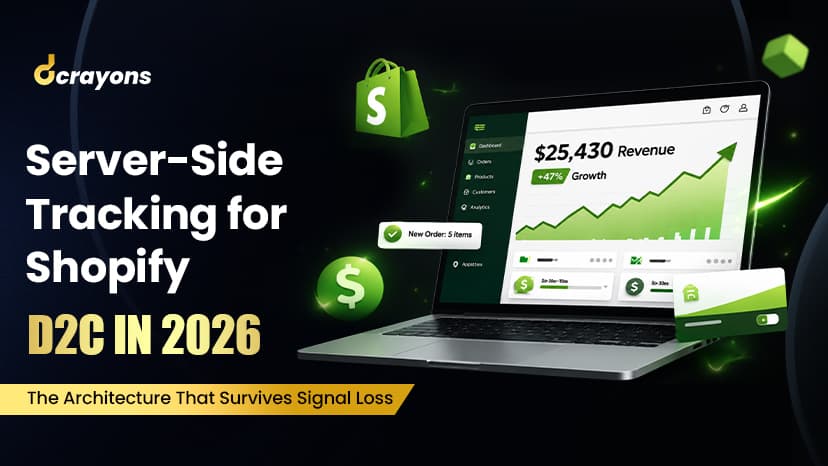
A Shopify D2C brand at Rs 30 crore ARR loses, on average, 22-38 percent of conversion data when it relies on browser-side pixels alone. That number got worse, not better, between 2023 and 2026: Safari's Intelligent Tracking Prevention tightened, Firefox followed, Chrome dropped third-party cookies, the DPDP Act came into force in India, and ad-blockers crossed 30 percent share on desktop.
The architectural answer is server-side tracking. This piece is the reference we apply on D2C engagements above Rs 20 crore ARR. It covers the deployment shape, the dedup discipline, the monitoring cadence, and the warehouse pattern that turns server-side data into a strategic asset, not just an ad-platform input.
Why server-side beats client-side in 2026
Three forces dismantled the browser pixel:
| Force | Impact on browser pixel | Server-side mitigation |
|---|---|---|
| iOS 14.5+ ATT framework (2021-present) | iOS users opt-out drops attribution to ~15-30% | First-party server data unaffected by ATT |
| Third-party cookie deprecation (Chrome 2024) | Cross-site retargeting + view-through tracking breaks | Server events use first-party hashed identifiers |
| Ad-blocker prevalence (~30% desktop, ~12% mobile) | Pixel never fires for blocked sessions | Server bypasses the browser entirely |
| DPDP / GDPR / state-level privacy laws | Consent-gated client tracking shrinks signal | Server respects consent + maintains data lineage |
The browser pixel still exists in a clean 2026 setup. It runs in parallel with the server side. Meta + Google + TikTok + LinkedIn de-duplicate by event ID so neither double-counts.
The deployment shape: four options that actually work
Option 1: Shopify's native CAPI integration (the entry point)
Shopify's Facebook & Instagram app + Google channel app both send server-side events to their respective platforms when you flip the "Maximum data sharing" toggle. This is the fastest path to baseline server-side coverage. It takes 30 minutes.
Strengths
- Zero infrastructure to operate
- Automatic event_id deduplication with the browser pixel
- PII hashed to platform spec out of the box
Limits
- Only standard events (Purchase, AddToCart, ViewContent, InitiateCheckout)
- No custom events or backend enrichment
- Cannot stitch in CRM data (LTV, customer tier, region segment) at the event level
For brands under Rs 20 crore ARR, the native integration covers 80 percent of value. Above that scale, you need more control.
Option 2: Server-side Google Tag Manager (sGTM)
A sGTM container hosted on Vercel, Cloud Run, or your own infrastructure receives client-side events from a regular GTM container, enriches them server-side, and dispatches to Meta CAPI, Google CAPI, TikTok Events API, LinkedIn Insight Tag, and any other endpoint you wire up.
This is the dominant pattern for mid-to-large D2C in 2026.
When sGTM is the right choice
- You run more than one ad platform
- You want a single instrumentation source feeding multiple destinations
- You need custom events beyond the standard set
- The team has TypeScript or JavaScript comfort
The hosted-on-Vercel pattern (sGTM container as a Next.js API route or a separate Vercel project) means deployment is git-push-driven, certificates are managed for you, and the container scales without operator attention.
Option 3: CDP-driven (RudderStack, Segment, custom)
The CDP is the event-of-record. Server-side tracking is one of many CDP destinations.
When the CDP path is the right choice
- You already operate a CDP for other reasons (marketing automation, warehouse pipeline, analytics)
- You want unified identity resolution across web + app + offline
- Your team values vendor neutrality more than the speed of a single-vendor setup
The CDP path is operationally cleaner at the multi-brand or multi-region scale. It is the longest setup time of the four options.
Option 4: Custom server-to-server
The Shopify backend (via Shopify Functions, Order Created webhooks, or a custom middleware) writes events directly to a dispatcher service that fans them out to ad platforms.
When custom is the right choice
- Data-residency requirements forbid third-party CDP routing
- Latency matters (sub-100ms server event delivery)
- The event shape is so custom that off-the-shelf templates don't fit (B2B order flow with quote approval, multi-step checkout, custom payment rails)
Build vs buy on this one: a custom dispatcher is 2-4 weeks of engineering plus ongoing ownership. Most brands do not need it.
The deduplication discipline
The most common failure of server-side tracking is silent double-counting. Meta or Google receives the same conversion via both the browser pixel and the server event, fails to dedupe, and reports inflated numbers. The advertising team trusts the inflated numbers, the warehouse-side analytics shows the real (lower) numbers, and the team spends weeks arguing about which is right.
How event_id deduplication works
Every conversion event gets a unique event_id (Meta) or transaction_id (Google) generated on the browser side. The server-side event for the SAME conversion carries the SAME event_id. The platform's ingestion layer compares incoming events; matching IDs collapse to one counted conversion.
What breaks dedup
- Different event_ids on browser + server. Often happens when the server-side dispatch generates a fresh UUID instead of reading the browser-generated one. The fix: pass the browser event_id through to the server event, never regenerate.
- Event timing skew greater than the dedup window. Meta dedupes within 48 hours; Google within 24. Server events delayed beyond that window count as new conversions.
- One side fires, the other does not. A browser-only environment (ATT-restricted iOS) sends only the server event; a server-only event still counts once. This is correct. The risk is the opposite: a browser-only event with no server backup gets lost when the browser pixel fails.
How to validate dedup is working
In Meta Events Manager, the Diagnostics tab shows the Browser + Server event pair count. Healthy programmes show:
- Server event count >= Browser event count (server should always equal or exceed browser)
- Dedup percentage > 70 percent (most browser events should have a matching server event)
- Event Match Quality (EMQ) score 6.0 or higher per event type
EMQ below 6.0 means the platform cannot reliably match your hashed identifiers to real people. The algorithm under-performs. Fix EMQ before chasing other optimisations.
The warehouse pattern: where server-side data becomes strategic
Server-side tracking sends events to ad platforms. The same events should also land in your warehouse (Snowflake, BigQuery, ClickHouse, or whatever your stack uses). This is the data layer that decouples Dcrayons from ad-platform dashboards.
The fact table
A clean weekly fact table holds: timestamp, customer_id (hashed), event_type, product_sku, revenue, marginal cost, attribution_path (last-click + linear + data-driven). One row per event. The CDP or sGTM container writes there in parallel with ad-platform dispatches.
What the warehouse finds
- Cross-channel attribution. Reconcile Google's reported conversions vs Meta's vs Amazon's vs your warehouse fact table. The warehouse is the closest thing to ground truth.
- Custom attribution models. Run multi-touch attribution on your specific touch sequence, not the platform's generic model.
- Marketing-mix modeling input. Aggregate weekly into the MMM data shape. See our enterprise MMM reference architecture for the modeling pattern.
- LTV joining. Join conversion events to customer-LTV cohort data. Optimise paid media against lifetime value, not first-purchase value.
- Margin-aware bidding. Push margin data into Google Ads via Offline Conversion Imports + Meta via the Server Events API. The algorithm now optimises for contribution margin, not just revenue.
The warehouse-side fact table is the highest-use piece of the server-side architecture. Without it, server-side tracking is just "the new pixel". With it, server-side tracking becomes the foundation for everything else.
What does an EMQ score below 6.0 actually mean?
EMQ is Meta's measurement of identity-match quality between your CAPI events and the real people who triggered them. Below 6.0 means the platform cannot reliably match a meaningful share of your events.
Common root causes:
- Missing user data. The event has no email, no phone, no client_ip, no client_user_agent. Each missing field drops the match score. Send everything you have.
- Wrong hashing format. Meta expects SHA-256, lowercased, whitespace-trimmed. Off-by-one mistakes (uppercased emails, untrimmed phone) silently break matching.
- Missing fbc + fbp parameters. These are the Facebook Click ID + Browser ID cookies. Server events should include them when the browser pixel fired in the same session.
- Test traffic polluting production. Internal QA + bot traffic + manual test orders all dilute EMQ. Filter them out at ingestion.
A clean EMQ improvement programme typically lifts the score from 5.0-5.5 to 7.5-8.5 over 4-6 weeks. Algorithm performance improves proportionally.
Cost discipline
Server-side tracking is not free. The cost lines:
| Cost line | Typical Indian D2C at Rs 50 crore ARR |
|---|---|
| sGTM hosting (Vercel / Cloud Run) | Rs 25K-1L per month |
| CDP licence (Segment / RudderStack / Twilio) | Rs 2-15 lakh per year |
| Warehouse storage + compute (Snowflake / BigQuery) | Rs 1-8 lakh per month |
| Implementation + ongoing ops (internal or agency) | Rs 6-25 lakh per year |
For brands below Rs 10 crore ARR, the native Shopify integration is the right choice. The full server-side stack is over-engineered. For brands between Rs 10-50 crore, sGTM + warehouse is the sweet spot. Above Rs 50 crore, the CDP becomes operationally worth it.
Production checklist
For a Shopify D2C at Rs 25+ crore ARR moving to a full server-side stack:
- Native Shopify-Meta + Shopify-Google integrations enabled as the baseline
- sGTM container deployed (Vercel or Cloud Run) with Meta CAPI + Google CAPI + TikTok Events API tags
- event_id deduplication validated via Test Events for every standard event
- EMQ baseline captured + monthly review cadence active
- Aggregated Event Measurement (AEM) 8-event ranking locked
- Conversion-data integrity stack: Enhanced Conversions (Web + Leads) + Offline Conversion Imports + CAPI parallel
- Warehouse fact table populated via CDP or sGTM dual-write pattern
- Cross-channel attribution dashboard built (warehouse view of conversions, joined with ad spend per channel)
- Margin-aware bidding wired (warehouse margin data feeds Google + Meta via Offline Conversion + Server Events APIs)
- Cost monitoring per cost line, monthly review
- Compliance: DPDP / GDPR consent honoured at the CDP layer, sensitive PII never reaches platforms beyond hashed form
- Quarterly governance review: signal quality, attribution reconciliation, cost vs business outcome
References + linked context
- Dcrayons glossary: conversions-api, smart-bidding, advantage-plus, mta, cdp
- Dcrayons paid-media reference architectures: Google Ads, Meta Ads, MMM in 2026
- Shopify CAPI tutorial (mid-market): How to Set Up Meta CAPI on Shopify
Server-side tracking is the platform decision your CFO will quietly thank you for in three years. If your stack is hitting a signal-loss wall, an EMQ ceiling, or a warehouse-attribution gap, reach out via the contact form for a 30-minute review of your current setup.