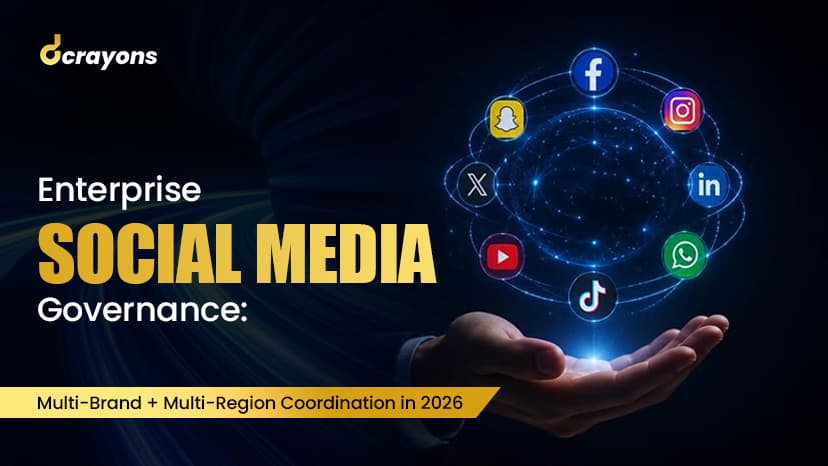
A single-brand D2C team running one Instagram + one Facebook + one LinkedIn page treats social media as a creative function. A multi-brand house operating 5 brands across India + GCC + UK across 6 platforms treats social media as an operational function with governance, crisis response, and audit posture.
This is the reference architecture we apply on enterprise social engagements. It covers account topology, content approval workflow, crisis response playbooks, and the operational cadence that keeps the programme honest.
Why governance matters more than creativity at scale
A creative miss on a single account costs a brand. A creative miss on a brand-house Instagram account during a sensitive news cycle costs the holding company a board meeting + an apology tour + a multi-week pause in posting cadence while the team figures out what went wrong.
The 2024-2026 era saw at least four high-profile brand crises trigger from social posts that went out without proper review. Each case had the same shape: small team, fast publishing cadence, no documented approval step, weak crisis playbook. The fix is governance, not better creative briefs.
Account topology: who owns what
The first architectural decision is the account ownership map.
Per-brand, per-region account inventory
For a holding company with 4 brands across India + UAE + UK + US, the realistic account count:
| Brand | India | UAE | UK | US |
|---|---|---|---|---|
| Brand A | IG + FB + LinkedIn + YouTube | IG + FB | IG + FB + LinkedIn | IG |
| Brand B | IG + FB + LinkedIn + YouTube + TikTok | IG + FB + TikTok | None | IG + TikTok |
| Brand C | IG + FB + LinkedIn | IG | IG + LinkedIn | None |
| Brand D | IG + FB + Twitter/X + LinkedIn + YouTube | IG | None | None |
That is 35+ active accounts. Each needs an owner, a posting cadence, a brand voice guideline, and a crisis-response path.
Centralised vs federated control
Two governance shapes:
Centralised. Holding company social team owns posting access for every account. Brand teams brief; central team executes. Better consistency, slower velocity, single point of failure.
Federated. Each brand team posts to their own accounts. Holding company sets brand voice + crisis policy + audit rights. Faster velocity, higher consistency variance, harder to enforce policy.
The 2026 hybrid pattern: federated execution + centralised governance. Each brand team owns day-to-day posting; holding company owns:
- Brand voice guidelines + creative standards
- Crisis-response triggers + escalation paths
- Quarterly account-audit rights
- Sensitive-topic approval gates (any post touching news, religion, politics, sensitive regional issues routes through central review)
Access control + Business Manager governance
Every account managed via Meta Business Manager (for Meta), LinkedIn Pages Admin (for LinkedIn), YouTube Brand Account (for YouTube). Two roles per account:
- Admin (1-2 people). billing, ownership, sensitive changes
- Editor (3-7 people). post, schedule, respond to comments
Two-factor authentication mandatory for Admins. Recovery codes stored in the holding company's password manager. Documented protocol for what happens when an Admin departs (rotate access within 24 hours).
Content approval workflow
Most social posts go out without formal approval. That works at speed but breaks at risk.
The four-tier approval workflow
| Tier | Content type | Approval gate |
|---|---|---|
| Tier 1 (auto-publish) | Standard product posts, day-to-day brand content, community responses | Brand team posts directly |
| Tier 2 (peer review) | Promotional campaigns, sale announcements, influencer collabs | One peer reviewer signs off before scheduling |
| Tier 3 (brand lead review) | Founder-led content, anniversary content, milestone posts | Brand lead signs off |
| Tier 4 (central + legal review) | Any post touching politics, religion, news, regional sensitivity, regulatory claims | Central team + legal sign off |
The skill is recognising which tier a post belongs to BEFORE it ships. Train every editor on the tier flags.
Tier flags that always escalate to Tier 4
- Mention of any political figure or party
- Mention of any religious symbol, festival, or community
- Comment on any current news event (positive OR negative)
- Health, financial, or efficacy claim about a product
- Use of a competitor's brand name
- Use of regional language content not previously approved
- Anything featuring a child, a minor, or a sensitive demographic
A team that internalises this list ships fewer crises. A team that doesn't will eventually run into a Tier 4 situation without the safeguard.
Crisis response: the playbook that exists BEFORE you need it
A crisis playbook written during a crisis is too late. The right time to write it is when nothing is wrong.
The five-stage crisis response
Stage 1: detection (target: within 60 minutes). Monitoring tools (Brand24, Mention, Hootsuite Insights, Sprout Social) alert when:
- Negative-sentiment spike on any brand account
- High-volume comments on a specific post
- Trending hashtag mentioning the brand
- Press / influencer / public figure mentioning the brand
A named team member is responsible for first review within 60 minutes during business hours, 4 hours overnight.
Stage 2: triage (target: within 2 hours). First-line responder classifies:
| Level | Definition | Response |
|---|---|---|
| P3 | Routine negative feedback (product issue, customer service) | Customer service responds; no escalation |
| P2 | Coordinated negative campaign or vocal critic with significant reach | Brand lead reviews; written response within 6 hours |
| P1 | Brand reputation at material risk (mainstream media, regulator, public figure) | Crisis team activated within 2 hours |
| P0 | Existential risk (CEO statement, regulatory action) | Executive team + legal + PR firm involved within 1 hour |
Stage 3: response (target: within 6 hours). Pre-approved response templates ready for the common scenarios:
- Product defect or recall
- Customer service complaint going viral
- Competitor attack
- Misinformation about the brand
- Sensitive cultural / political misstep
Response goes through Tier 4 approval before posting. No off-the-cuff replies from the brand account.
Stage 4: containment (24-48 hours). Pause scheduled non-crisis content. Monitor sentiment + reach. Iterate the response based on community reception.
Stage 5: post-mortem (within 7 days). Documented review:
- What happened
- What worked in the response
- What didn't work
- What changes to the playbook based on the learning
The playbook is a living document. Every crisis updates it.
The operational rhythm
Sustainable enterprise social media programmes follow a documented cadence.
Daily
- Comment + DM review across active accounts (responses within SLA: 2 hours for IG/FB, 4 hours for LinkedIn, 24 hours for TikTok)
- Sentiment alert review (any spike in negative mentions)
- Crisis monitor checked + escalations triaged
Weekly
- Content calendar review: what's locked for this week, drafts for next week, briefs for week +2
- Top + bottom 5 posts per account analyzed: what worked, what didn't, what to repeat
- Influencer relationships review: active partnerships, deliverables tracking, payment status
Monthly
- Cross-account performance review (engagement rate, follower growth, share-of-voice vs competitors)
- Content mix analysis (product-focused vs lifestyle vs founder vs community)
- Cadence review: are we hitting the published cadence per account?
Quarterly
- Brand voice audit: drift detected, corrections applied
- Sentiment analysis report: trend over the quarter
- Cross-region coordination review
- Crisis playbook walkthrough (tabletop exercise without an actual crisis)
Annually
- Tooling review (monitoring + scheduling + analytics platforms)
- Account-access audit (rotate admins, remove departed staff)
- Strategy refresh (which accounts to grow, retire, or consolidate)
Tooling stack
For an enterprise programme with 35+ accounts:
| Function | Common choices | Rough annual cost |
|---|---|---|
| Scheduling + publishing | Hootsuite, Sprout Social, Buffer for Business, Later, Sprinklr | Rs 6-50 lakh/year |
| Listening + sentiment | Brand24, Mention, Talkwalker, Sprinklr, Meltwater | Rs 12-60 lakh/year |
| Influencer management | GRIN, Aspire, CreatorIQ, Upfluence | Rs 15-50 lakh/year |
| Analytics + reporting | Native platform analytics, plus aggregation via Sprout / Sprinklr | Bundled or Rs 5-20 lakh/year |
| Crisis management | PR firm retainer + escalation workflow | Rs 12-50 lakh/year |
Most Indian holding companies start with Hootsuite + Brand24 + the founder's PR firm contact, then graduate to Sprinklr + Meltwater at scale.
What goes wrong (and why governance fixes it)
Five recurring failure modes:
- A junior posts a sensitive opinion from the brand account. Governance: Tier 4 approval gate + trained editors + documented tier flags.
- Two regional accounts post contradictory messaging on the same day. Governance: weekly cross-region content review + shared content calendar.
- A crisis hits during a weekend when no one is monitoring. Governance: 24x7 monitoring SLA + escalation tree with on-call responsibility.
- A departed employee's social access remains active for months. Governance: quarterly access audit + offboarding checklist + Business Manager 2FA.
- A creative agency posts on the brand's behalf without internal review. Governance: agency contract clauses + internal approval workflow + audit-log right.
Production checklist
For an enterprise social media programme operating 15+ active accounts:
- Account inventory documented per brand per region per platform
- Centralised governance + federated execution model agreed in writing
- Two-factor authentication on every Admin account; recovery codes secured
- Four-tier approval workflow + tier-flag training delivered
- Crisis response playbook documented + tabletop-tested quarterly
- Monitoring + alerting platform deployed; named first-line responder per shift
- Response SLA per platform documented + measured monthly
- Content calendar + cross-region coordination cadence active
- Daily / weekly / monthly / quarterly / annual operating rhythm with named owners
- Tooling stack reviewed annually; cost vs outcome assessed
- Account-access audit + offboarding protocol; quarterly review
- Brand voice guidelines + crisis policy in writing; refreshed annually
References + linked context
- Dcrayons glossary: marketing-automation, lifecycle-stage
- Dcrayons reference architectures: Enterprise HubSpot, Enterprise Lifecycle Marketing
- Mid-market practitioner guide: How to Build a Content Calendar for Your D2C Brand
Social media governance is the discipline that prevents the bad day from becoming a bad year. If your enterprise programme has hit a multi-brand coordination gap, a crisis-response readiness question, or an account-access audit issue, reach out via the contact form for a 30-minute review of your current setup.