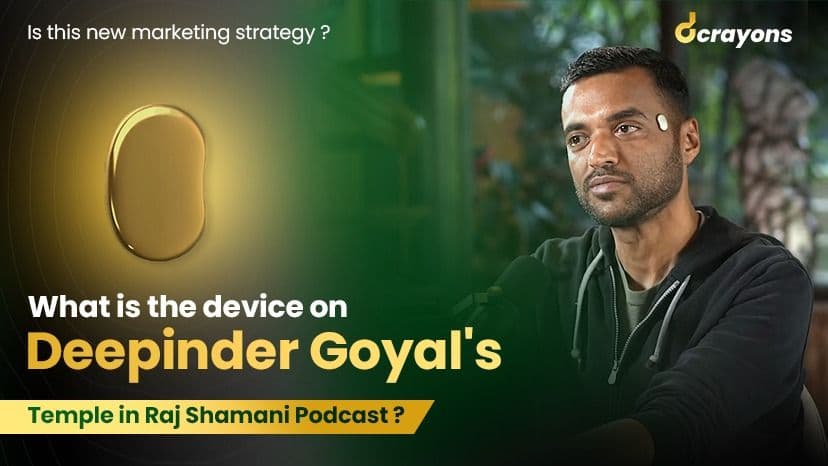
When Deepinder Goyal, the founder and long-time CEO of Zomato and now the leader of parent company Eternal, appeared on Raj Shamani's "Figuring Out" podcast in early January 2026, viewers were immediately struck not by his insights on business and entrepreneurship but by a tiny metallic gadget clipped near his temple. Within hours, social media lit up with speculation: Was it chewing gum? A patch? A quirky fashion accessory? Some even joked it looked like an "external SSD."
But the truth behind the device called "Temple" is far more intriguing, ambitious, and unusual. It doesn't just sit on the surface of a founder's forehead; it sits at the frontier of early health-tech research, neuroscience curiosity, and perhaps the future of preventive wellness.
1. What Is a "Temple"? The Device on Goyal's Temple Explained
The device that Goyal was seen wearing on his temple is Temple, a small experimental wearable that can continuously monitor brain blood flow in real time. The stated purpose of Temple is to measure cerebral blood flow, one of the most vital yet least-studied physiological measures associated with brain health, cognition, ageing and neurological performance. compared to mainstream fitness wearables, which measure heart rate, steps or sleep patterns.
The main principle of the device is deceptively simple: if technology is able to track the flow of blood in the brain 24/7, this could open the door to rich insights into trends in neurological health that could hardly be achieved through the conventional clinical tests that are sporadic and confined to hospitals.
Even though the technical specifications have not been publicly disclosed, there are reports of a device with sensors (possibly optical, electrical or even AI-based signal processing) that approximate blood flow and circulation dynamics around the skull and the temple area, near major cerebral arteries.
2. How Did Temple Come About? The Science and Motivation Behind It
Temple is not a random accessory or a PR stunt. Its development stems from Goyal's personal research initiative partly conducted under the banner of Continue Research, an independent research effort he's funded with his own money. According to reports, Goyal has invested tens of millions of dollars (about $25 million / Rs 225 crore) into this work.
At the center of this research is something Goyal refers to as the "Gravity Ageing Hypothesis." This idea proposes that gravity. the very force that keeps us upright. might gradually affect cerebral blood flow over decades, subtly influencing brain health and ageing patterns. While this hypothesis remains unconventional and highly speculative, it provided the impetus for building a tool that could measure something humans have rarely been able to monitor outside clinical settings.
In Goyal's own words, as shared on social media and in interviews, Temple was created to "calculate Brain Flow accurately, in real time and continuously." More importantly, Goyal has stressed that this device is about scientific exploration rather than commercial success, at least at its current stage.
3. What Does the Device Actually Monitor? Cerebral Blood Flow in Focus
Temple's purpose of measuring blood flow to the brain is rooted in a growing body of neuroscience research that sees cerebral blood flow (CBF) as an important biomarker. Changes in CBF are linked with cognitive performance, stress, fatigue, ageing, and even some neurological diseases. Continuous monitoring could, in theory, reveal trends over time that occasional clinical tests miss.
For example, if a person's blood flow measurements significantly decline over weeks or months, that information. paired with other health data. might indicate early warning signs of cognitive stress or declining neurological robustness. In contrast, stable or high flow might correlate with sustained cognitive engagement or good vascular health.
If Temple truly functions as described, it represents a departure from everything most consumers associate with wearable tech: rather than measuring movement or heart rate, it attempts to quantify an internal physiological process that typically requires specialized medical equipment.
4. Was the Podcast Appearance a Marketing Strategy or Something Else?
Almost immediately after Goyal's appearance on the Raj Shamani podcast, a new question took over social platforms: "Was this a calculated marketing stunt?" The device's unexpected visibility sparked theories that Goyal intentionally used the high-profile platform to build hype and awareness for Temple long before any official launch.
To assess that claim, it's important to consider what is and what isn't being marketed:
Not a Consumer Product Yet
Despite the buzz and speculation, Temple is not currently a consumer product available for purchase. The device is experimental, not commercially launched, and has no public price, app, or retail ecosystem. Goyal's team has not communicated distribution plans, pre-orders, or marketing collateral the way consumer electronics companies typically do.
No Direct Sales Messaging During the Podcast
Goyal did not use the podcast appearance to sell the device or push viewers to a website, newsletter, or pre-registration list. The episode itself focused on his entrepreneurial journey and broader industry topics. The visibility of Temple was incidental, not the subject of a direct pitch.
Public Statements Deny a Marketing Ploy
Goyal has, in a way, debunked the idea that the Gravity Ageing Hypothesis was invented specifically to make Temple more sellable. In his earlier comments to mainstream media and on his social media profiles, he has framed the hypothesis and the device as legitimate inquiries into the nature of things rather than as marketing tools.
All of this together indicates that the podcast appearance was not a traditional marketing technique as far as a product campaign goes. It was rather a glimpse of a product that was still being developed. akin to a prototype disclosure, but no more than that.
Nonetheless, the attention that it generated did assist in making the project known to the public, investors, and tech media. This exposure, whether intentional or not, raises the stature of Temple in a way that few nascent research projects have ever enjoyed.
5. What Does This Mean for Wearable Tech and Brain Health?
The broader implications of Temple's emergence go well beyond one podcast appearance. If a small wearable that monitors cerebral blood flow, even in rough or early form, proves viable, it could signal a new frontier for wearable health technology: one that moves beyond pulse, blood oxygen, or step tracking toward deeper physiological data.
Major questions remain:
Scientific Validation
Cerebral blood flow is complex, and many researchers caution that accurate, continuous measurement outside clinical settings is extremely difficult. Any claims about health insights, ageing correlations, or therapeutic value would require rigorous scientific validation.
Ethical and Regulatory Oversight
Devices that collect sensitive neurological data raise ethical, privacy, and regulatory considerations. How such data is stored, interpreted, and protected. if Temple ever becomes a consumer product. will matter significantly.
Market Readiness
Consumers have been gradually adopting wearables that monitor health metrics (heart rate, sleep, oxygen saturation). But widespread use of neurological monitoring tools is still nascent. Temple's early exposure could accelerate adoption. or it could highlight how far the technology still needs to go.
Overall Summary
The gadget on Deepinder Goyal's temple is not just an aesthetic curiosity but an experiment in wearable neurological health monitoring. Although it was initially seen as an attention-grabbing accessory, the underlying narrative is one of personal scientific discovery, early-stage health technology development, and the blurred lines between scientific research and social media in the digital era.
Although Temple is not a mass-market product, and it was not released using viral marketing, its sudden appearance in a popular podcast has put brain health wearables on the conversation map. both an outcome of accidental publicity and of authentic scientific curiosity. Whatever happens to Temple as a commercial product, it will leave a mark on the way the world perceives wearable technology, brain health and preventive wellness in the future.