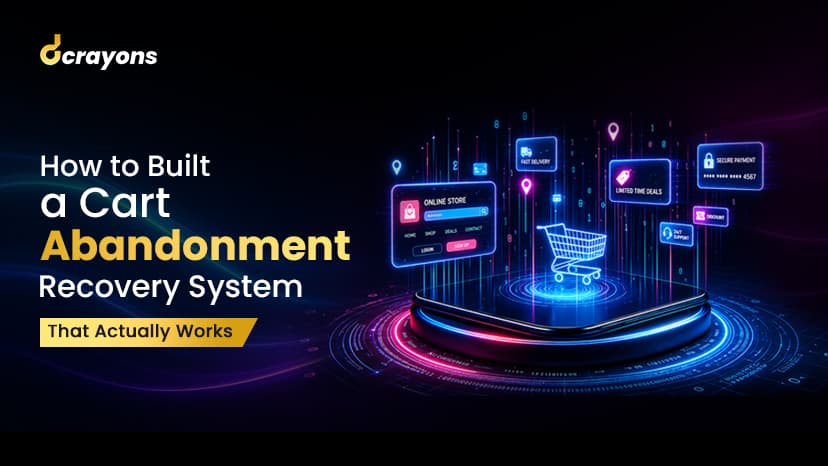
70-80 percent of online shopping carts get abandoned. For a Shopify D2C at Rs 30 crore ARR, that's roughly Rs 9-15 crore of annual revenue walking away. A well-built cart-abandonment recovery system recovers 8-18 percent of that gap. The difference between "well-built" and "default" can be 4-5x.
This guide is the practical playbook for building a recovery system that actually works in 2026. It assumes you have a Shopify (or similar) store + a marketing automation platform (Klaviyo / MoEngage / Postscript / WebEngage). It covers segmentation, channel sequencing, timing, and the discipline that separates strong programmes from email spam.
Why default cart-abandonment programmes under-deliver
Most stores set up Shopify's native abandoned-cart email (or a Klaviyo basic flow), send one email 1 hour after abandonment, see a 4-6 percent recovery rate, and assume that's the ceiling.
The actual ceiling is 15-22 percent. The gap is in three things default programmes miss:
Segmentation. sending the same message to a Rs 500 abandoned cart + a Rs 8,000 abandoned cart wastes both. Different cart values + customer histories want different messages.
Multi-channel sequencing. email alone caps recovery at 6-9 percent. SMS adds 3-5 percent. WhatsApp (where consent exists) adds another 2-4 percent. Channels stack.
Timing discipline. most programmes fire too late OR too aggressively. The 2026 timing pattern looks different from 2018's "1 hour then 24 hours then 72 hours" template.
The 4-stage architecture
A modern cart-abandonment system has four sequential stages, each addressing a different recovery dynamic.
Stage 1: the immediate nudge (15-90 minutes post-abandonment)
The customer is still in shopping mood. Mild nudge wins more than aggressive discount.
- Channel: Email primary; WhatsApp secondary if opted-in
- Message: "You left something behind" + product image + 1-tap-to-resume-checkout link
- NO discount yet. you don't want to train customers to abandon for discounts
- Trigger window: 15 minutes for high-intent signals (cart > Rs 2,000 AND added to cart > 30s); 60 minutes for medium-intent; 90 minutes for low-intent
Stage 2: the consideration follow-up (4-24 hours post-abandonment)
The customer has moved on with their day. Re-anchor on the value.
- Channel: Email + SMS (SMS only if cart > Rs 1,000)
- Message: Social proof (reviews from buyers of this product) + brand reassurance (returns policy, shipping speed, certifications)
- Optional: 5 percent discount IF cart value > Rs 3,000 AND customer is first-time-buyer; skip discount for known repeat customers
- Trigger window: 4 hours for medium-intent; 24 hours for low-intent
Stage 3: the urgency layer (24-48 hours)
The customer has clearly disengaged. Last push before retiring the cart.
- Channel: Email + SMS + WhatsApp (where consent exists)
- Message: Limited-time discount (10-15 percent) OR scarcity (limited stock, sale ending)
- Critical: this message goes ONLY to customers who haven't engaged with stage 1 or 2. Don't bombard the engaged ones.
- Trigger window: 24-48 hours post-abandonment
Stage 4: the long-tail (7-30 days)
The cart is dead but the customer may come back. Soft re-engagement.
- Channel: Email only
- Message: "Still thinking about it?" + bestseller alternative + brand story
- No discount in this stage (we already offered in stage 3)
- Trigger window: Day 7 + Day 21 (two touches max)
Segmentation: where the use lives
The same sequence doesn't fit every abandoner. Five segments matter.
Segment 1: first-time-visitor + low cart value (< Rs 1,000)
Default sequence is fine. Don't over-invest in recovery; don't discount.
Segment 2: first-time-visitor + medium cart value (Rs 1,000 - Rs 5,000)
Sequence runs as designed. Consider 5 percent stage-2 discount.
Segment 3: first-time-visitor + high cart value (> Rs 5,000)
Earlier urgency (stage 3 fires at 12 hours not 24), bigger discount (12-15 percent), include phone call from sales for very high cart values (> Rs 20,000).
Segment 4: returning customer (has purchased before)
NO discount in any stage (loyalty erosion risk). Personalised message based on past purchase: "Looks like you forgot to checkout your [product type] cart. Quick note: we updated the formula in our [past purchased product]". Brand intimacy > price reduction.
Segment 5: loyalty-tier customer (top 10% by LTV)
Skip the standard sequence entirely. Send ONE highly personalised message from the founder or a real account manager: "Hi [name], I noticed you started a cart but didn't finish. Anything I can help with?" White-glove treatment.
Implementing segmentation
In Klaviyo / MoEngage / WebEngage:
- Conditional split at the top of the flow based on customer-tier + cart-value
- Different flow branches per segment
- Different content per branch
- Performance tracked per segment
Channel sequencing rules
Email: always the foundation
Email is consent-driven (opt-in at signup), has the largest sendable audience, and is the cheapest channel. Every stage uses email.
SMS: powerful but expensive + risky
SMS in India is regulated (DLT registration mandatory for transactional + promotional templates). It commands attention but exhausts goodwill if overused.
- ONLY for customers with explicit SMS opt-in
- ONLY in stages 2 + 3 (not stage 1; not stage 4)
- ONLY for cart value above threshold (typically Rs 1,000)
- Maximum 2 SMS per cart-abandonment sequence
WhatsApp Business API: high engagement, requires opt-in
WhatsApp open rates are 70-90 percent (vs 20-30 percent for email + 60-80 percent for SMS). But WhatsApp is opt-in + template-approval governed.
- ONLY for customers with explicit WhatsApp opt-in
- Templates pre-approved with Meta (no ad-hoc messaging)
- Use for stages 2 + 3 alongside email
- Maximum 2 WhatsApp messages per cart-abandonment sequence
Push notifications (if you have a mobile app)
Brand-app users get push notifications. Higher engagement than email + cheaper than SMS. Same staging rules.
Channel mix per stage (typical)
| Stage | SMS | Push | ||
|---|---|---|---|---|
| Stage 1 (15-90 min) | Yes | No | Optional | Yes |
| Stage 2 (4-24 hrs) | Yes | If > Rs 1K | If opted-in | Yes |
| Stage 3 (24-48 hrs) | Yes | If > Rs 1K | If opted-in | Yes |
| Stage 4 (7-30 days) | Yes | No | No | Yes |
Timing precision: when small adjustments compound
Sub-optimal timing drops recovery by 30-50 percent. Three patterns to internalise.
Pattern 1: time-of-day matters
Sending the stage 1 email at 2 AM IST when the customer abandoned at 11 PM is wasted. Most marketing platforms support send-time optimisation: queue the message + send at the recipient's most-engaged hour.
Pattern 2: day-of-week matters
A cart abandoned at 7 PM Saturday + recovered Sunday afternoon converts at much higher rates than the same cart abandoned at 4 PM Tuesday. Weekend abandonment is often "I'll think about it"; weekday abandonment is often "phone vibrated, lost focus". The timing of recovery should respect this.
Pattern 3: don't fire during sale events
If your brand is running a Diwali sale + the customer abandoned during peak sale hours, the recovery sequence colliding with sale emails creates inbox fatigue. Pause cart-abandonment flows during your own sale events; resume after.
The metrics that actually matter
Beyond "recovery rate", four metrics tell the story:
| Metric | What it measures | Target |
|---|---|---|
| Recovery rate (total) | Recovered orders / abandoned carts | 12-20% best-in-class |
| Recovery rate per stage | What share each stage contributes | Stage 1: 40-55%; Stage 2: 25-35%; Stage 3: 15-25%; Stage 4: 5-15% |
| Revenue per email | Recovered revenue / emails sent | Rs 50-200 per send for healthy programmes |
| Unsubscribe rate per stage | New unsubs / sends per stage | Below 0.5% per send |
If recovery rate is healthy but unsubscribe rate climbs, you're sending too aggressively + burning the list.
What does this look like in practice?
A real-world snapshot for a beauty D2C at Rs 25 crore ARR:
- Abandoned carts per week: ~12,000
- Recovered orders per week: ~1,800 (15 percent recovery rate)
- Revenue recovered per week: ~Rs 22 lakh
- Cost per week: ~Rs 15K (email + SMS + WhatsApp combined)
- ROI: 145x on the recovery programme
The numbers compound: at this performance, the recovery programme adds Rs 11 crore annually to revenue at a cost of Rs 7.5 lakh in messaging spend.
Common failure modes
- One-size-fits-all sequence. Same email to Rs 500 + Rs 50,000 cart. Both segments unsubscribe.
- Discount in stage 1. Trains customers to abandon-then-checkout for the discount.
- Stage 3 missing. The 24-48 hour urgency message is where 20-30 percent of recovery happens; many programmes skip it.
- No suppression. Customer who already purchased gets the "you left something behind" email an hour later. Suppression rules prevent this.
- SMS / WhatsApp without opt-in. DPDP + DLT non-compliance; fines + reputational risk.
- No A/B testing. Subject lines, send times, content variants. none tested. Compounding suboptimality.
- Cart-abandonment flows colliding with sale-event campaigns. Inbox fatigue + unsubscribes.
Production checklist
For a cart-abandonment recovery programme aimed at 12-20% recovery rate:
- Marketing automation platform deployed (Klaviyo / MoEngage / WebEngage)
- 4-stage sequence designed + deployed
- 5-segment branching based on customer tier + cart value
- Channel mix per stage (Email + SMS + WhatsApp + Push) with consent gating
- Time-of-day + day-of-week optimisation enabled
- Suppression rules (purchased → suppress, already-active-in-other-flow → suppress)
- DLT-registered SMS templates + WhatsApp Business API pre-approved templates
- Performance dashboard: recovery rate total + per stage + per segment + per channel
- A/B testing cadence on subject lines + content + timing
- Unsubscribe + complaint monitoring per stage
- Quarterly programme review + sequence refresh
- Compliance: DPDP + DLT + WhatsApp Business policy adherence
References + linked context
- Dcrayons glossary: marketing-automation, lifecycle-stage, customer-360, dunning
- Dcrayons reference architectures: Enterprise Lifecycle Marketing, Enterprise D2C on Shopify
- Related practitioner guide: How to Build a Content Calendar
Cart-abandonment recovery is the easiest revenue line to add to a D2C business + the most commonly under-optimised. If your programme is hitting a recovery-rate plateau or you haven't built one yet, reach out via the contact form for a 30-minute review.