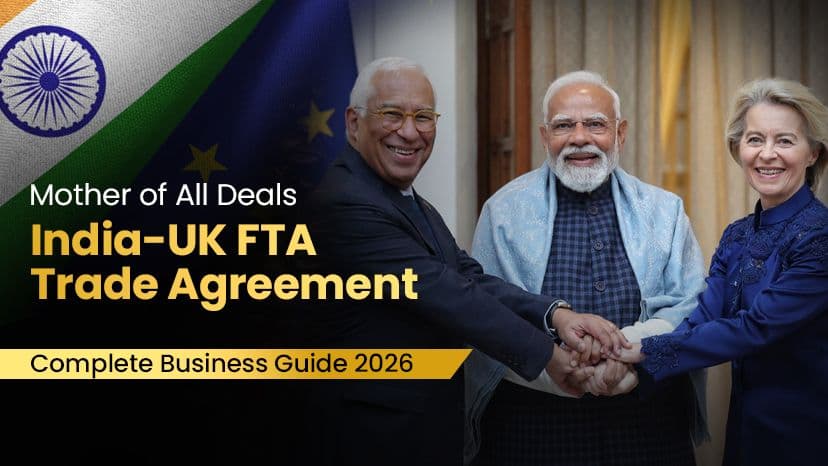
What Is the "Mother of All Deals"?
The India-UK Free Trade Agreement is a comprehensive bilateral trade deal covering goods, services, investments, intellectual property, digital trade, and labour mobility. It eliminates or reduces tariffs on 99 percent of products, making trade easier between both nations.
Key Highlights
- Trade potential: USD 50 plus billion annually.
- Tariff coverage: 99 percent of tariff lines.
- Annual savings: Rs 1 lakh crore for Indian exporters.
Tariff Elimination Timeline
- Day 1 (2025): 65 percent of UK tariffs eliminated. immediate duty-free access for majority of Indian exports.
- Year 3 (2028): 85 percent tariff lines covered. Phase 2 reductions.
- Year 7 (2032): 99 percent duty-free trade achieved.
- Year 10 (2035): Full implementation of all provisions.
Who Benefits? Sectors That Win Big
Textiles and Apparel
Tariff drops from 12 percent to 0. Annual savings: Rs 8,000 crore. Ready-made garments, fabrics, and home textiles gain immediate access.
Leather Goods
Tariff drops from 8 percent to 0. Annual savings: Rs 2,500 crore. Footwear, bags, and leather garments become highly competitive.
Gems and Jewelry
Tariff drops from 2.5 percent to 0. Annual savings: Rs 1,800 crore. Cut diamonds, gold jewelry, and silver items benefit.
IT Services
Enhanced market access with easier work visas, recognition of Indian qualifications, and simplified company registration in the UK.
Pharmaceuticals
Tariff drops from 0-6.5 percent to 0. Generic medicines, APIs, and formulations gain competitive advantage.
Marine Products
Tariff drops from 20 percent to 0. Annual savings: Rs 3,200 crore. Shrimp, fish, and seafood exports become highly profitable.
Benefits for Business Owners
Indian SMEs and startups can now compete on equal footing with UK domestic producers. The tariff elimination means your products become 10-20 percent more competitive overnight.
Export Opportunities
- Lower costs. no duties means higher margins or more competitive pricing.
- Easier compliance with streamlined customs procedures.
- Quality recognition through mutual recognition of standards.
- Direct market access with reduced need for UK-based intermediaries.
Service Sector Gains
For IT companies and professional service providers: Mode 4 access for easier temporary work visas, recognition of Indian degrees and certifications, digital trade provisions for remote work, and easier establishment of UK subsidiaries.
Who Might Face Challenges?
While the deal is overwhelmingly positive, some sectors may face increased competition from UK imports:
- Scotch whisky competitors.
- Luxury car dealers (UK imports become cheaper).
- Some dairy producers.
- Premium chocolate makers.
- High-end machinery sectors.
India has protected sensitive sectors like agriculture, dairy, and automobiles with tariff reductions excluded or phased over 10 plus years.
How to Capitalize on the FTA
Step 1: Assess Export Readiness
- Check if your products qualify for duty-free treatment.
- Understand UK market requirements and standards.
- Calculate cost advantage from tariff elimination.
- Identify potential UK buyers and partners.
Step 2: Build UK Market Presence
- Register on UK trade portals and B2B platforms.
- Participate in UK trade fairs and exhibitions.
- Consider UK warehousing for faster delivery.
- Develop UK-specific marketing materials.
Step 3: Use Government Support
- MEIS / RoDTEP export incentive schemes.
- ECGC export credit insurance.
- EXIM Bank export financing.
- India Trade Promotion Organisation for market access support.
Frequently Asked Questions
Q: When will the India-UK FTA come into effect?
The FTA was signed in May 2025 and is expected to come into full effect by late 2025, with some provisions implemented in phases over 3-10 years.
Q: Which industries benefit most?
Key beneficiaries include textiles and apparel, leather goods, gems and jewelry, IT services, pharmaceuticals, marine products, and food processing sectors.
Q: How does it help Indian IT professionals?
The FTA includes provisions for easier work visas, mutual recognition of qualifications, and improved mobility for IT professionals.
Conclusion
This transformational opportunity opens the UK market. one of the world's most valuable. to Indian businesses on unprecedented terms. Whether you are a textile manufacturer in Tirupur, a leather exporter in Kanpur, or an IT company in Bangalore, the UK market is now more accessible than ever.
Key takeaway: Act now. Early movers will capture market share before competition intensifies. The India-UK FTA opens a Rs 35,000 plus crore opportunity for Indian exporters.